Saturday, March 22, 2014

Weddings


Weddings

 In the space of three months, I attended three weddings or, more accurately, three evening parties. The evening party is only one part of the wedding, as I’ll explain. For the record, all three brides gave me permission to publish photographs from their weddings on this blog.

Traditional Thai weddings extend over two days. The first day is at the home of the bride’s or groom’s parents. Monks are invited to give blessings and the family makes merit by giving them gifts of food and money. Usually only family members and very close friends are invited. I’m not sure what other events take place the first day.

The second day may be at the home of the bride’s parents, or it may be held at a hotel or banquet hall. Either way, the ceremonies, which are extremely important to the families as a means of making public the couple’s commitment to each other, do not confer legal status on the marriage.  The couple must register their marriage at the district office to have it legally recognized.

The first bride who invited me to her wedding is Mie (pronounced “me”), an English teacher at a school near here, and a friend of my co-teacher’s. The first day’s events took place at her parents’ home. Here is a picture of the bride and groom kneeling to receive blessings.


The evening party was on the second day, at a hotel in the city where the groom works, about three hours from here. The picture below shows what the banquet room looked like before guests began arriving.

 The next picture shows the groom having entered the room singing to his bride – he is a musician and composer. His plan had been to surprise her with his serenade, but in the end he had to tell her, because she kept asking why he needed a spotlight. The lack of surprise doesn’t seem to have spoiled the fun.

 Here I am with my co-teacher, Nook-Nik (standing between her friends Kim and Tookta) and another teacher, Chinnakorn. Nook-Nik and Chinnakorn were the Emcees for the evening. They had rehearsed their lines, and had scripts to keep them focused on messages about family, commitment, and love.

 The second invitation came from my former host family in the village – I lived with them from April through July before moving into a rental house. The bride is my host “sister” (much younger than me); she and her son were living with her parents/my host “parents.” The wedding invitation came on a Sunday. I was at home, working on this and that, and had been hearing music and merrymaking in the village off and on during the day but hadn’t checked it out. When a student came over for her English tutoring session in the afternoon, I asked her what was going on.  Oh, she said, someone is getting married.  Two hours later my former host “father” showed up to hand-deliver an invitation and told me to be at their house by 6pm! Short notice, but doubtless he thought I knew about the wedding, since everyone else in the village did. As an aside, all three brides hand-delivered their wedding invitation or had someone hand-deliver it for them. Surely they must have mailed invitations to people who live far away, but personal delivery seems to be preferred.

Here is the bride under a balloon arch in the yard. All parts of this wedding took place at her family’s home.

The next picture shows Gung, the bride, and Noi, her husband, with their parents on the stage that was erected for speeches and karaoke. The words above their heads spell Gung and Noi in Thai letters. The man behind Gung is a family friend.

The speeches at this party were more casual and teasing than at Mie’s wedding, but totally good-natured and inoffensive. I was asked to make a speech too, with the option do it in English, but I managed to say almost everything in Thai. Here I am at a table with the bride and groom behind me. I’m wearing a cotton jacket that is typical for this area (Isaan/northeastern Thailand); it was a gift from the bride.

Unfortunately I couldn't attend the ceremonies that took place the following day (Monday – a school day!), but Gung generously shared pictures with me.  This is a picture of Gung and her parents sitting on the bed that the parents and other family members had prepared for the couple.

Preparing the marriage bed is an old custom that is performed to ensure a happy and long-lasting relationship. The bed is supposed to be made by an elderly couple whose own marriage is of long duration. Each of the three brides incorporated this tradition into her wedding.

The next picture shows Gung and Noi seated in a circle of family and friends in her parents’ home, getting ready for the string ceremony, which is part of every significant event. (You can read more about this tradition in my first post, “Thai String-Tying Ceremony”). You can see the strings draped over small rods, which people will tie around the couple’s wrists shortly.
The picture below is included just because the bride and groom look so happy and festive in their beautiful wedding clothes.

The third invitation was from Nook-Nik, my co-teacher. The first day’s ceremonies for family and close friends took place at the home of her husband’s family in a different province. The evening party was on the second day, at a school in the town where her parents live. The assembly hall was transformed into a banquet hall. Here is the image she used on the cover of the wedding invitation, enlarged as a cardboard cutout to show the way into the hall.

In the picture below, you see the couple greeting their guests for photo ops. There were well over 200 guests at this wedding, which meant a lot of pictures for Nook-Nik and her husband, Dui, to pose for!

The next picture shows me and three fellow-teachers at our table – as you can see, there was plenty of food.

The three weddings had similar menus. First there are appetizers (nuts, pickled vegetables, fresh vegetables, crackers, sauces). Next, heartier appetizers appear– usually seafood. Then there is soup. After that, a large grilled fish shows up on a big platter, delicately seasoned and sprinkled with fresh herbs. So you are starting to think, all right, are we full yet? And then there is more, usually a pork dish of some kind, maybe meat and vegetables cooked at the table, also fried rice. Finally, a big platter of fruit will be delivered. There are buckets of ice, bottles of water, soft drinks, and beer, and a bottle of whiskey on each table. The whiskey has the amusing name of Hong Thong, but before you get any funny ideas, thong (pronounced “tong”) means “gold” (in color) and I think “hong” means swan – so, golden swan, not a bad name for whiskey, hm?  Most of the time, only the men drink whiskey. The contents of those bottles vanish in a hurry, and a new bottle appears as soon as the first one is empty. This type of meal is served at all festive events, not just weddings.

Back to the wedding: Finally all the guests had arrived, so Nik and Dui could stop posing for photo-ops and enter the hall. The groom didn’t come in singing this time, but later in the evening, the bride sang a song to him, in English (“How can I live without you?”). I had wanted to show you a short video of their entrance, but when it hadn't uploaded after two hours, I decided to give it a miss.
Instead, here are Nik and Dui at the end of the evening, going around to all the tables to thank everyone for coming.

After all this, I thought you might be wondering about differences between American and Thai weddings, so I made a brief Q + A.

Do the couples exchange vows?  - No, that’s not part of Thai tradition. They stand with their parents in front of the guests, thank their parents for all they’ve done for them, and affirm their love for their parents and each other.

Do the couples exchange rings?  -- Yes, this is done at the engagement party.

What about bridesmaids? Best man? – I’m not sure how this works here. You can see, in the picture of Mie’s husband singing to her, that the bride is accompanied by two friends wearing the wedding’s theme color and a little boy with a bouquet, but I don’t know what their role is other than to walk her in. The Emcees, who are usually close friends of the bride, have some responsibilities similar to those of best man and maid of honor, notably making speeches. Nook-Nik’s Emcee was her sister – who in turn got married two months later, with Nik as her Emcee.

When do they open their gifts? – Usually, the guests give money. You put it into the envelope the invitation came in (which has your name on the front, so the bride and groom will know who it’s from) and drop it into a bowl or box at the sign-in table. After you sign the guest book, you are given a little keepsake of the wedding, such as a tiny teacup, painted glass, or key ring.

What about wedding cake?  -- I’ve read that there may be wedding cake, but it wasn’t part of these weddings as far as I know. Remember, though, I only attended the evening parties.

Dancing! Is there dancing? – There was some dancing at Mie’s wedding, and also at Nik’s, after the dinner and all speeches were finished. But it didn’t go on into the night like at American weddings. Most guests left by about 10pm. I’m not sure, but my guess is that dancing at Gung’s wedding, at her parents’ house, would have gone on into the wee hours, but I had gone home.

You may have more questions – and there’s more to learn about Thai weddings.  But I’m out of answers for now.


Another Piece of the Puzzle


Another Piece of the Puzzle
Academic Competitions in Thailand

Understanding the role of academic competitions in Thai education has taken me a while, and parts of the picture are still missing. Here, I’ll just try to describe what I’ve learned so far.

As in the US, there are competitions in every academic subject. Coaching students who will compete is an important and time-consuming responsibility for Thai teachers. At our school, teachers hand-pick their students early in the summer semester, to prepare for the first round of competitions in July. For our school, the first round is within our network area of thirteen schools. Winners move up the hierarchy to their district, then to the provincial level, and, if successful there, to the regional competition (there are 77 provinces in Thailand and five regions). Regional winners proceed to the national competition in Bangkok, in February. This year, three students from our school did well in Bangkok, all of them in the computer category. Two got second places and one got a fourth place. Everyone was very proud of them.

The contests in English – impromptu speech, spelling bee, storytelling, and multi-skill – are premised on rote learning. Spelling bees in Thailand are similar to American ones, except that no word lists are published in advance. I believe that multi-skill (reading, writing, listening and speaking) is a multiple-choice test, but I haven’t participated in that contest yet, so am not sure.

Impromptu speech is somewhat of a misnomer, since the students must prepare memorized speeches on several topics (announced in advance, typically, “My School,” “My Family,” “My Free Time,” My Environment”). The impromptu aspect lies in not knowing your topic until the last minute – each student draws a topic right before their turn to speak, which is very stressful. Those who don’t have a memorized speech on the topic they draw can speak on something else, but must forfeit a significant number of points. Quite a few choose that option anyway, because if they know their prepared speech well, they might get full points on everything but content (e.g., form, delivery, pronunciation, etc.), and thus come out with a respectable score, though most likely not as a winner. In this contest, you hear quite a few students reciting speeches without knowing what they are saying, a sad consequence of the emphasis on rote learning.

Storytelling also requires memorization, but the student memorizes only one story and there are no last-minute surprises. They are expected to use gestures, different voices, movement, and sound effects to dramatize the story, so there is room for individual creativity. Probably the stories are also easier to remember because they have a plot, interesting characters needing to solve problems, repetition of key lines, and a moral lesson – all lacking from the impromptu topics. I was a judge for storytelling at a regional competition in Mukdahan province, which is on the Mekong River across from Laos.
My co-teacher, a friend, and me, and Laos across the river

Each contestant gives the judges a printed copy of their story.  The other judges (there were four of us) followed along reading the text while the students were speaking, but I decided to consult it only if I got totally lost – which happened a few times. For example, in one Thai tale, a character is transformed into a white squirrel – a phrase that is virtually impossible for a Thai speaker to say, because the sounds “r” and “l” occur in the same word. In my notes I wrote “white skirt?” “white scare?” and then realized I’d better look at the text

Every event must have a banner . . .

I was surprised to see how few students chose Thai tales or tales from other Asian traditions – however, it’s likely that fewer such tales are readily available in good, “tellable” English translations. The stories that were most often chosen by the 60 students who competed here are: Cinderella (6 contestants); The Three Little Pigs (5); Little Red Riding Hood (4); The Wolf and the Seven Little Goats, The Lion and the Mouse, Snow White (3 each); The Little Mermaid, Rapunzel, The Lion and the Oxen, The Little Ladybug’s Dream, and Thumbelina (2 each). In general, fairy tales and tales from Aesop were the most popular. Students were enthusiastic in their use of sound effects and dramatic actions (crying, trembling, rejoicing, etc.) – and several sang songs as well. A song is a great addition if your story is too short to meet the time requirement.

Later, I found some of the above tales in Thai bookstores, in editions containing the dread pronunciation glosses that spell English words with Thai letters (I wrote about this practice in an earlier post, “Sound Barriers”). I believe these glosses help account for some of the storytellers’ error-ridden pronunciation. I wanted to wave the fairy godmother’s magic wand and turn those glosses back into pumpkins!


Besides the traditional academic contests, Thailand also has competitions on knowledge about ASEAN (Association of South East Asian Nations), in keeping with the national mandate to educate youth about the ASEAN countries prior to launching the ASEAN Economic Community (AEC) in 2015. Based on the vendors’ displays at competitions, there is a thriving industry in ASEAN-related teaching materials – maps, flags, posters, books, CDs, DVDs, lesson plans, quizzes, puzzles, games, buttons, stickers, dolls with clothing and hairdos typical of various ethnic groups in the 10 countries, and much more. Some contests in Thailand's ASEAN competitions are in English, because English will be the AEC’s language of communication, and is already the working language for ASEAN meetings, official documents, and so on.  

For ASEAN competitions, I’ve twice served as a judge for “English Debate,” which, unlike the contests described so far, doesn’t depend on rote learning. It’s a challenging contest because it requires not only a relatively strong command of English, but also content knowledge and ability to think on one’s feet.

The first time I served as judge for English Debate was in our district. It was painful. The team members couldn’t remember the points they were supposed to make, had to read from their written notes, and couldn’t understand what the other side was saying. I felt sorry for the students and wished they could have been assigned to a contest more in line with their abilities – at the time, I hadn’t met any Thai students whose English was strong enough to handle this contest. Weak performances notwithstanding, the team that did slightly better than the others went on to the provincial level. I have no idea how they fared.

The second time I served as a judge for English Debate was at a competition for our region (Northeast) in Khon Kaen.  I was assigned to a category for students who attend private schools or public schools with special English programs – prior to this event, I hadn’t known that such schools existed. The special programs are for selected students only, are taught by native speakers, and provide extra learning experiences, such as the opportunity to take several courses taught in English (e.g., social studies, government, etc.) in addition to regular English classes. You won’t be surprised to hear that students from these schools fared much better in English Debate. My co-teacher colleague, seen with me in the picture below, was assigned to judge this contest with teams of students from “non-special” public schools. Predictably, they struggled with the challenges of English Debate..
Our contest rooms were in the basement, hence low ceilings

 The English Debate teams that I judged in Khon Kaen were a pleasure. Students came prepared with facts and arguments about the topic (the proposed opening up of international trade restrictions in the AEC). In all respects they were the opposite of the teams I had seen in our district – they didn’t recite or read from their notes, but knew what they were saying, understood what the opposing team members said, and could respond, with varying degrees of effectiveness (hey, they are high school students, after all!). Their native-speaker teachers were right there with them the entire time, chatting reassuringly, checking with the judges on small details of the contest rules, and coaching the students up to the last minute. No wonder they did so well!

As someone whose role in Thailand is to help enhance the teaching of English, I have often railed against the academic competitions, which seem at cross-purposes with the Thai Education Ministry’s stated goal of moving away from rote learning and toward more communicative, participatory teaching and learning. Here is a link to a recent article on this subject: http://www.chiangraitimes.com/education-minister-says-english-teaching-reform-in-thailand-begins-this-year.html

If we are supposed to promote better communicative skills, I would ask my English teacher colleagues, why do we make students spend so much time memorizing a speech they don’t understand and that has no intrinsic value? They could learn so much more by spending those hours in listening and speaking practice. Why do we ask them to participate in an English debate that is simply beyond their abilities at this point and would be too difficult for many of their teachers? I didn’t get much by way of answers to these questions but I gradually understood more about the role of the academic competitions in Thai education.

First, I believe it is simply true that Thai academic competitions, like Thai national exams (a topic for a separate post!), are indeed at odds with the goals of education reform. Many Thai educators agree that rote learning does not foster creativity, critical thinking, or independent learning. (A link at the end of this post will take you to a Thai cartoon that makes this point.)  Academic contests that reward rote learning are however still supported by the education ministry despite the contradictions, no doubt because no one has come up with any suitable alternatives. English Debate is a positive example of a contest that rewards oral fluency and critical thinking, but the level of fluency needed is out of reach for students at many schools, where English classes still emphasize grammar and memorization, and there are no special programs for motivated students. The goals for change look good on paper, and it’s very encouraging that some public schools can offer special programs for English. Still, implementing education reform down through the hierarchy, all the way to rural schools like ours, will be difficult to say the least. And most teachers, understandably, won’t change their teaching approaches as long as students are still required to take national exams based on rote learning.

Second, I learned that success at academic competitions is not only for students – though obviously each win, at whatever level in the hierarchy, is a reason for them to celebrate. However, the success of these students is also an important way for teachers to earn points toward a promotion. My co-teacher explained this during one of our conversations about why teachers put students through these ordeals (as they seem to me). A student she coached was a top winner in Bangkok two years ago. As you can imagine, this is a well-deserved enhancement to her resume and a boost to her self-image.  In a later conversation, I learned that our school principal achieved a promotion this year based in part on two first-place winners from our school, the student just mentioned (coached by my co-teacher) and one coached by a talented social studies teacher who left our school last July – but was teaching here when her student won a first place in Bangkok. So, the winning students enhance the reputation of the entire school

Understanding these aspects of student participation in academic competitions didn’t make me feel a lot better about what the students must go through – but of course Thai teachers have to play the hand they’ve been dealt. It would be great if the reforms promised by the education minister (stated in the article linked above) could lead not just to a reshuffle, but a new deck.  Dream on?

Disclaimer: The opinions expressed in this post are mine and do not reflect the perspective of the Peace Corps, its employees, or any American agency.

Link to cartoon: 
https://www.google.co.th/search?q=cartoons+thai+education&client=firefox-a&hs=3SC&sa=N&rls=org.mozilla:en-US:official&channel=sb&tbm=isch&tbo=u&source=univ&ei=WnsqU7_HNouFrAfJ-4GQDw&ved=0CDoQsAQ4Cg&biw=1025&bih=434#facrc=_&imgdii=_&imgrc=QcCNqvkrxYvxyM%253A%3BnWUxXcUdWBEwNM%3Bhttp%253A%252F%252Fpropelsteps.files.wordpress.com%252F2013%252F06%252Feducation-system-in-out-cartoon.jpg%253Fw%253D600%2526h%253D377%3Bhttp%253A%252F%252Fpropelsteps.wordpress.com%252F%3B600%3B314

Wednesday, March 12, 2014

Dog Bites Farang


Dog Bites Farang
And Other Stories

Farang is the Thai word for “foreigner,” specifically, foreigners with white skin. It dates back to the period of French colonialism in neighboring Laos, and is derived from “farantse” (=French), which was then generalized to all Europeans.

Dog Bites Farang.  I was bitten by a dog the other day. Dog bites are such a common occurrence for Peace Corps Volunteers in Thailand that one of our training topics is what to do when a dog starts chasing you on your bike (keep pedaling; shout “go home” in Thai; if you have a water bottle, you can try spraying the dog). A group of us who rode to the training site together each day found that ringing our bicycle bells worked pretty well – the dogs didn’t seem to like the sound and would drop back. Of course, we were also drilled on exactly what to do if we were bitten, as several members of our group were during our first months.

 Back to the story: Walking home from school, I stopped at one of the little stores looking for something to cook for supper. I didn’t see the dog, who bit me in the back of my left calf. She slunk away barking and snarling when I turned around to look. The storekeeper and various bystanders were very concerned (more so than I was – fortunately for me!).  The storekeeper washed my leg first with alcohol and then with soap and water. He knows the people the dog belongs to, and said they were out in their field working, i.e., not reachable to consult about the dog. It’s obvious that she’s nursing puppies. She was probably scrounging for food when I unknowingly stepped too close to her.

Seeing that the dog’s teeth had barely punctured the skin and there was no bleeding, I said, in Thai, “I don’t think it’s dangerous.” The others said, “It’s dangerous!” and started making phone calls. Soon one of my English colleagues picked me up and drove me to the nearest hospital where, per instructions via cell phone from the Peace Corps nurse in Bangkok, we went to the very quiet and un-crowded ER.  In due course I was given a rabies shot and instructions to come back in three days for another one. Then my colleague took me to one of his favorite noodle stands, so there was no need to buy anything for supper.

The next morning, when I was waiting for the song teo to go into town for grocery shopping, two women walking by asked me about my dog bite – news gets around fast in the village. So I showed them my leg and assured them I was okay. (A picture of my dog bite is at the end of this post so you can look at it or not, as you wish.) Later I stopped by the little store to thank the owner again for helping me. It occurred to me that if you have to get bitten by a dog, it would be good to do it here – the people in this village will take good care of you.  The dog seems to be holding a grudge – she barks and growls at me from across the street every time I walk past the little store, and the people there yell at her to go lay down, or words to that effect. Like the School Dogs described in an earlier post, barking dogs are just part of village life.

Farang in the Village.  Since arriving here a year ago, I’ve met four other farang who live in the village. Three are men in their sixties (a Brit, a Norwegian, and a German) married to local women. The fourth, a Finn in his thirties, shares the home of a Thai woman and her two children.  While there is truth to the stereotypes of Western men coming to Thailand for sexual adventure, these guys all seem to be very family-oriented, homebody types.

We farang stick out like sore thumbs in these surroundings. The Finn has blond hair down to his shoulders. The Norwegian, who must be at least six foot five, towers over everyone. The other two men, with their salt-and-pepper hair and beard stubble, are less striking but clearly European in appearance. I don’t know any of them well – I chat with them at the weekly market or in passing, and enjoy the opportunity to speak Deutsch with the German man from time to time.

Fear of Foreigners.  I was much taken aback at first when some (by no means all) small Thai children would cower and cling to their mothers when they saw me, for example on the song teo going to or from town. The three-year-old sister of an 8th-grade student who comes over for tutoring almost every week can’t get over her fear, despite weeks of effort by her older sister and their mom to reassure her. The mom, who is a bit embarrassed by the little girl’s behavior, has taught her to greet me with a “wai” and to wave bye-bye – but the closest she will come to me is to snatch a cookie or juice box and then only when I hold it at arm’s length.

What are the children so afraid of? Probably the main thing is my very different appearance. I’m reminded of my sister Joanie telling how she used to be afraid of our German great-grandfather when she was very little, because he had a big white mustache and spoke only German.  So, with my white hair (no bushy mustache, thank goodness) and speaking only English or strongly accented Thai, I must seem as scary to this little girl as Great-Grandpa Schimmel did to my sister all those years ago.  There is another possible factor as well: Several Thai acquaintances have confirmed my observation that sometimes the word “farang” is used to frighten children who are misbehaving – it reminds me of being threatened with “the boogey man” by the older students during one-room country school days.

Farang farang.  On one of my recent Saturday trips into town, the song teo was crammed full -- small children had to sit on laps, a couple of women sat on the floor, and two men, including one of the village farang mentioned above, sat facing out the back, on the top step of the bus. His little boy sat on the lap of a woman catty-corner across from me. He and another little boy, who was sitting next to me on his grandma's lap, amused themselves by pointing at things and giggling; I couldn't understand what they were saying. Then the one with the non-Thai dad started saying "farang farang" and giggling just non-stop while pointing his finger at me. Maybe you can picture how little kids point at something, with their finger not very straight and not always aimed exactly at its target. Of course I was the only farang on the song teo, besides the boy’s dad facing out the back. The boy with the foreigner dad giggled more than the other boy, who however did his share of giggling as well. But it went on so long – more than 10 minutes -- that I started wondering what it was really about, or rather, what a preschooler might think or feel about farang.  Maybe nothing much -- maybe the same kind of thing as when they start cracking up while repeating stuff like "The pig says oink," or “Boogers!” But yet, the boy is no doubt aware that his dad is a farang.  Maybe he's even been teased at preschool or in the neighborhood for having a foreign dad. I should add that no one on the song teo, including me, said anything to the boys about their game, or whatever it was, and the dad never turned around, although he could surely hear what they were saying. When we got to town, everyone went their separate ways as always.

Another day in the life of a farang in Thailand.

* * * * * *   
Disclaimer: As always, please remember that descriptions of my experiences here in Thailand are only descriptions, not judgments. Writing about being a farang in Thailand is a bit sensitive by the nature of the topic, however. So let me emphasize once again that these are my personal experiences and opinions, not those of the Peace Corps or any American agency, or anyone but me.

Wednesday, February 19, 2014

The Cow Said "Pig"?


The Cow Said “Pig”?
And Other Mysteries of Old MacDonald ‘s Farm

In January, it was decided that our school’s “English on Mondays” program was too limited for its goal of encouraging more students and teachers to speak English. So now, I’m to teach a few words of English to the students assembled at the flagpole every morning, after the daily rituals – the principal’s announcements, a story from the Jataka Tales, flag-raising and national anthem, prayers, and other business – are finished.

You may ask what it’s like to teach English to 600+ students from grades 1 through 12 who’ve been restless for about 30 minutes already and are hoping to be dismissed with time to play before classes start at 9am. Not exactly a cakewalk. Even 15 minutes is a lot of time to fill while trying to hold students’ attention in this situation. Thankfully, the time allotted has now been reduced from 15 minutes to five. Whew.

My teaching strategies so far consist of singing and TPR (=Total Physical Response). TPR is based on having learners associate actions with words, starting with simple action verbs such as stand up, sit down, run, dance, walk, skip, clap your hands, stomp your feet, turn around, etc.  Students listen, watch the teacher, and demonstrate that they understand the words by performing the actions. They learn to say the words before long, after listening and doing the actions many times. To keep it a bit more interesting while constantly recycling the same vocabulary, the students can be asked to do the actions fast or slow, or from right to left, backward or forward, or ask the boys to do one thing and the girls another. This last ploy always gets laughs from the students who were paying attention, at the expense of those who weren’t – inevitably there are boys who clap when I say “Girls, please clap your hands” and girls who dance when I say “Boys, please dance.” 

Since attention spans are not greater in Thailand than in the US, it’s best to change the activity or sing a different song about once a minute. Thai students like to sing, especially songs with actions to accompany the words, and they like to sing the same songs again and again. Walking to or from school, I usually hear neighborhood children singing lines from songs they learned at flagpole. The pictures below show me teaching the song “Good Morning,” which I got from a web site called dreamenglish.com – you can visit it if you want to learn the song yourself.
Raising arms for "Good Morning"

Holding arms out to spin around

A few brave students singing with me and a colleague

To teach a song that doesn’t have actions, I make some up, a strategy that can backfire if the actions aren’t familiar to the learners. I thought it would be fun to teach “Zip a dee doo dah,” snapping my fingers each time you sing “Zip,” and skipping to and fro on “my oh my what a wonderful day.” Trouble was, many or maybe most of the children couldn’t snap their fingers, which slowed us down a bit while they concentrated on trying to do it, ignoring the words. Now, about four weeks later, quite a few can snap their fingers very, er, snappily, even if they still haven’t got the words to the song down pat. But hey, progress is progress.

So, what about the topic of this post, “Old MacDonald Had a Farm.” I thought this song would be easy for our students to learn – and sure enough, they all caught on to “e-i-e-i-o” almost instantly. However, they didn’t sing along with “on this farm he had a cow” or “moo, moo here” etc. as I had expected, and gave me blank looks when I repeated the lines. The reason is simple enough, and I should have anticipated it. Thai people say that the cow (wua) says “maw maw,” not “moo moo” – which sounds to them like the Thai word for “pig” (muu).  So when they heard “with a moo moo here, moo moo there” the students no doubt thought I was saying “pig pig.”  What sense does that make? No wonder they didn’t sing along.

Just to keep things interesting, the pig doesn’t say “oink oink” in Thai, but “oot oot,” and the duck doesn’t say “quack quack,” but “gop gop.”  At least “oink” and “quack” don’t sound like Thai names of other farm animals, so that’s some consolation. The duck is difficult for another reason, however – Thai people have a hard time hearing the difference between “duck” and “dog,” and tend to pronounce the two words more or less the same. Also, dogs don’t say “bow wow” in Thai, but “hong hong.” What a zoo, uh, barnyard.

Note to self: Next time, start with the sheep, the chickens, and the cat, whose vocalizations in Thai are very similar to the ones in English.

Teaching “Old MacDonald” to Thai students made me think of our much-loved professor in the Indiana University Germanic Studies Department, Dr. Frank Banta, who died in January at the age of 95. I remembered his taking about a half hour of class one day to ask us what the various animal sounds were in the languages we knew – English, French, German, Russian, Latvian, and maybe some others. It was a fun activity – but I can’t recall what point he wanted to make.  Was it to disprove the onomatopoeia theory of the origins of human language? Was it just for our amusement?  Or what?  Maybe someone on this list who was in the same class (it was either Comparative Linguistics or History of the German Language) will remember.  – I would so like to be able to tell Frank about teaching “Old MacDonald Had a Farm” to Thai students. It would probably amuse him, and maybe he’d remember what his point was in that class all those years ago.  R.I.P. Frank, you were totally the best, and we miss you acutely.


A Funeral


A Funeral
December 2013

This post is a lightly edited version of what I wrote immediately after the funeral of a boy from our school. I hesitated before deciding to publish it in order to gain a little distance from the emotions of the event.  As always, I want to emphasize that my intent is only to describe what I see and experience, not to judge it.

The funeral was on a Monday afternoon.  A 9th grade boy had died in a motorcycle accident the Friday before. Someone told me that he ran into a cow or bull. He wasn’t wearing a helmet. I didn’t have him as a student, but recognized him when I saw his picture at the funeral.

It was a chilly rainy day, the roads were muddy. A fellow-teacher drove us out to the home of the boy’s family, a mile or two from the school.  A coffin-like box, only taller than coffins we are used to in the US, was inside the house, with paper flower wreaths and also real flowers around it and on top.  We took off our shoes and knee-walked toward the coffin where there were incense sticks for us to light. There were pictures of the boy on easels nearby, and there was a “tree” for people to hang money on.  Doing a little research later, I learned that it is customary in Buddhist funeral practices to have the body of the deceased person on display for three, five, or seven days before cremation. This would have been the third day.

Soon after we arrived, the coffin was loaded onto a pickup truck to be taken to the site where the cremations take place. Someone holding a green string attached to the coffin walked ahead of the pickup truck – when I asked why, my colleague said that the string would lead the boy’s spirit to where it needed to go. The mourners followed the pickup truck to a site about a half-mile down the road, just past the entrance to a nearby wat.  Quite a few people were already there, gathered under the shelter you see below or standing around it with umbrellas. 


 The coffin was under a canopy in a clearing, facing the shelter. There was cloth festooned over the coffin, and a frame of very light wood or bamboo. Flowers were piled over the coffin and around the funeral pyre made of logs. Several men were chopping coconuts open and pouring the water off into plastic bottles. Students walked through the crowd carrying trays with glasses of water and soft drinks, but not many people wanted any.

After a while there were some speeches – I couldn’t see who was speaking and didn’t understand everything that was said, but could hear the words for teachers, students, school, and so on – of course, most everyone from our school was there, especially students and teachers from the grades that were closest to the boy in age. The school band played a piece I didn’t recognize. After the speeches were finished, a monk chanted for what must have been about 20 minutes, followed by a round of chanting interspersed with responses from the mourners, a sequence that was repeated a couple of times. After that, all attention turned to the coffin, which was on a structure of logs in the clearing pictured below.

Someone carried the flower wreaths away from the coffin, the canopy was carried off to one side, and the decorated part of the coffin itself was taken away – presumably to be used again by someone else. A table was set up near the coffin with little homemade paper flowers for everyone to take and put next to the body. When I took one, I saw that the flowers were made of paper that documents had been printed on, or that someone had written and drawn pictures on. I thought about the boy’s family and friends making the flowers with whatever paper they happened to have, so as to be ready in time for the ritual.

Everyone lined up to walk to the coffin, lay one of the flowers beside it, and pour a little coconut water over the boy.  So that’s what the coconuts were for. He lay there looking very natural, as if he were asleep. I didn’t ask what his fatal injuries were. One of our students just ahead of me, carrying his saxophone, was crying – I felt so sorry for him to have lost his friend.  After we walked back through the mud, my two colleagues poured water over each other’s hands, and mine, the water blessing.

Then the structure the boy was lying in was dismantled (made of cloth and light wood), and logs were piled all around and over him, like a little house. The light wood pieces were tossed on top.  Men poured something on the logs (probably gasoline, I was too far away to smell it) and the fire was started.  I stood there crying, wondering how his parents could possibly stand it. Then I remembered hearing Thai people who had recently had a death in their family say something like: “Yesterday I sent my dear [name of relative] to heaven” – that is, the cremation is a positive event, because it carries the deceased person’s spirit up to heaven.

When we walked back out to the car, the boy’s mother and sister were standing in the driveway holding his picture and thanking people for coming.  I was introduced to them and, of course, someone took our picture. 

Except for the monks (five of them) and the person who picked up the flower wreaths and the decorative part of the coffin, the funeral seemed to be a community effort. The men loading the coffin onto the pickup truck and off again, the students carrying trays of soft drinks, the men opening the coconuts, carrying the logs and lighting them – these were not funeral parlor professionals, but ordinary people helping their bereaved friends. Later, they would also collect the ashes and clear the site to make it ready for the next cremation. Another example of the collectivist aspect of Thai culture.

From reading about Thai funeral practices, I learned that wats in cities and towns often have crematoria, and the rituals may be more elaborate. However, the practices described above are quite typical of funerals in rural communities in northeastern Thailand.

Friday, January 24, 2014

Children's Day


Children’s Day

In Thailand, Children’s Day is a national event that falls on the second Saturday in January every year.  The Friday before Children’s Day has been designated Students’ Day at our school, with games, entertainment, and prize drawings. This year, several elementary classes (pratom) gave dance performances. Students in the upper grades (mattayom) had booths or stalls with games where you could test your skills or try your luck to win prizes.

Arriving at school on Students’ Day, I was pleasantly surprised by how colorful it all was, in contrast to regular school days.  Students who would be performing later in the morning were wearing their costumes and makeup. The other students were wearing ordinary clothes instead of their uniforms, that is, clothes of many colors rather than all the same. Here are the students gathered for the daily flagpole ritual and speech from the school principal:


To emphasize that the students are the most important people on Students’ Day, most teachers (except me) wore student uniforms; women in the white blouses and blue skirts that the girls wear on Mondays, and male teachers in white shirts and brown shorts.


Dance performances by student groups were scheduled throughout the morning, beginning with the youngest students and continuing through Grade 6. I made way too many videos of students dancing but am posting only two, both by students in some of my classes – not that I had any role in their practice sessions or rehearsals.  On the contrary, I was surprised to learn how many students in my Levels 4 and 5 were performing in dance groups. The first video below is a short excerpt from the performance by Level 4.

The next video is from the performance by students from Level 5, who had much flashier costumes than Level 4, but also the ongoing danger of wardrobe malfunctions. The theme of cross-dressing, noted in a couple of earlier posts, shows up here as well. Can you tell which three dancers are boys?


In between performances I browsed game booths, which included musical chairs (shades of my one-room country school!), opportunities to win prizes by throwing balls to knock down bottles or dolls, and one in which contestants blow powdered sugar off a small object on a plate and then pick it up with their teeth.


The game in the photo below is familiar, though I can't remember what it's called, so I named it Balloon Stomp.

Prize drawings throughout the morning kept students milling around the stage hoping to win snacks or a toy.  After the dance performances were finished, there were opportunities to win prizes by playing Balloon Stomp or Musical Chairs.

The day ended with a prize drawing for a new bicycle donated by the school principal – the big event that everyone had been waiting for. The first students whose names were called must have already gone home, since they did not come forward.  Watch what happened next:

The girl whose name was read out after the toss is one of those students everyone wants more of -- always eager to participate in class, high achieving, a frequent winner for her summaries of the stories read during morning flagpole time (described in an earlier post, “Flagpole Tales”), and just a really great kid to have around.  You’ll recognize her from the Level 4 dance performance, above.

It was fun to see how much the students enjoyed Students’ Day, and especially to see them working together in their performances. Whatever you may think of their costumes and the dance moves, it seems clear to me that the students were really just having a great time, and were proud to show off how well they had learned their routines. It makes me want to make language teaching more like the arts, where students become so engaged in the creative process that they forget they’re learning something. Easier said than done, huh.

The following day, January 11th, was Children’s Day in Thailand. Government offices in larger towns and cities are open to children and their families on that day, with opportunities for children to be the Thai equivalent of Mayor for a Day, for example.  This year the government announced, with apologies, that Children’s Day activities in Bangkok would be curtailed “because of security concerns” related to ongoing political protests and demonstrations.  Both the Caretaker Prime Minister, Yingluck Shinawatra, and the leader of the anti-government protest demonstrations, Suthep Thaugsuban, published slogans that encapsulate their advice to children.

Ms Yingluck’s 2014 slogan for children is: Be grateful. Know your duty. Be good. Have discipline. Make Thailand strong.  Mr. Suthep’s is: Think smart, love the country, love the King, be honest, and stay Thai. – Words that the two leaders might want to take to heart themselves.

If you wish, you can click on the link below to see a Bangkok Post article for students, in “Easy English” and with many pictures, about Children’s Day 2014.


Monday, January 13, 2014

New Year's Tourists


New Year’s Tourists

Look for this post to be long on pictures and short on content.  My New Year’s trip was to Chiang Mai and Pai in northern Thailand. Tours and treks that my PCV pal Yee and I wanted to take were at capacity before we even asked – but not before we’d bought bus tickets. Chiang Mai is a major city with a long history, a well-regarded university, numerous temples, a famous night market, and several excellent museums – which were closed for the New Year’s holidays.  Oh well.

So we had a lazy vacation, sightseeing, strolling, shopping and taking pictures.  Here’s a hotel we stayed at in Chiang Mai and the demon that guards it – note the similarity to the Grand Palace demons:
In Chiang Mai, we spent a couple evenings taking in the free entertainment at an open-air New Year’s festival and market with vendors hawking every kind of craft and souvenir and food stalls for every taste. Two emcees kept up an informative chatter (one speaking Thai, one speaking English) about the performances, with frequent reminders of the festival’s “no alcohol, no smoking” policy – unusual in Thailand, as far as I can judge. Among the entertainers were traditional Thai dancers, musicians and singers of various persuasions, and several groups of young male dancers in their teens, of the style I believe is called K-Pop. In between performances there were contests, raffles and prizes (festival T-shirts) for audience members. 


At the market we found many Hmong vendors with beautiful handmade clothing, pillows, quilts, table runners . . . you name it.  You are expected to offer less than the vendor asks – and if they accept your offer, you just bought something. I’m not good at bargaining, especially over goods that clearly took days or possibly weeks to finish.  But at least I know enough not to answer the question “How much you want to pay?” – if the vendor should happen to accept, see above. Yee speaks the Hmong language fluently (her family emigrated to the US when she was very small). I’m not sure what her conversation with the woman selling bedspreads was about, but the price went down 1500 baht (about $50) – so I bought one in my favorite colors. The picture shows about half of it – it’s harder than I thought to photograph a bedspread.  

 Want a receipt for what you bought?  Dream on.

From Chiang Mai, we went farther north to Pai, a four-hour mini-bus ride through the mountains. Pai is a scenic village with (of course) a street market, street entertainment in the evenings, many restaurants, bars and coffee houses, and various attractions that sound interesting but are mostly photo ops. For example, the strawberry farm has a modest-sized strawberry field, as you can see in the photo below:


 However, mainly it sells strawberry products – strawberry jam, dried strawberries, candied strawberries, strawberry wine, mugs with strawberries on them, etc.  The wine was unmemorable.  Here are a couple of the photos we took.
Yee in archway
Me as Giant Mutant Strawberry

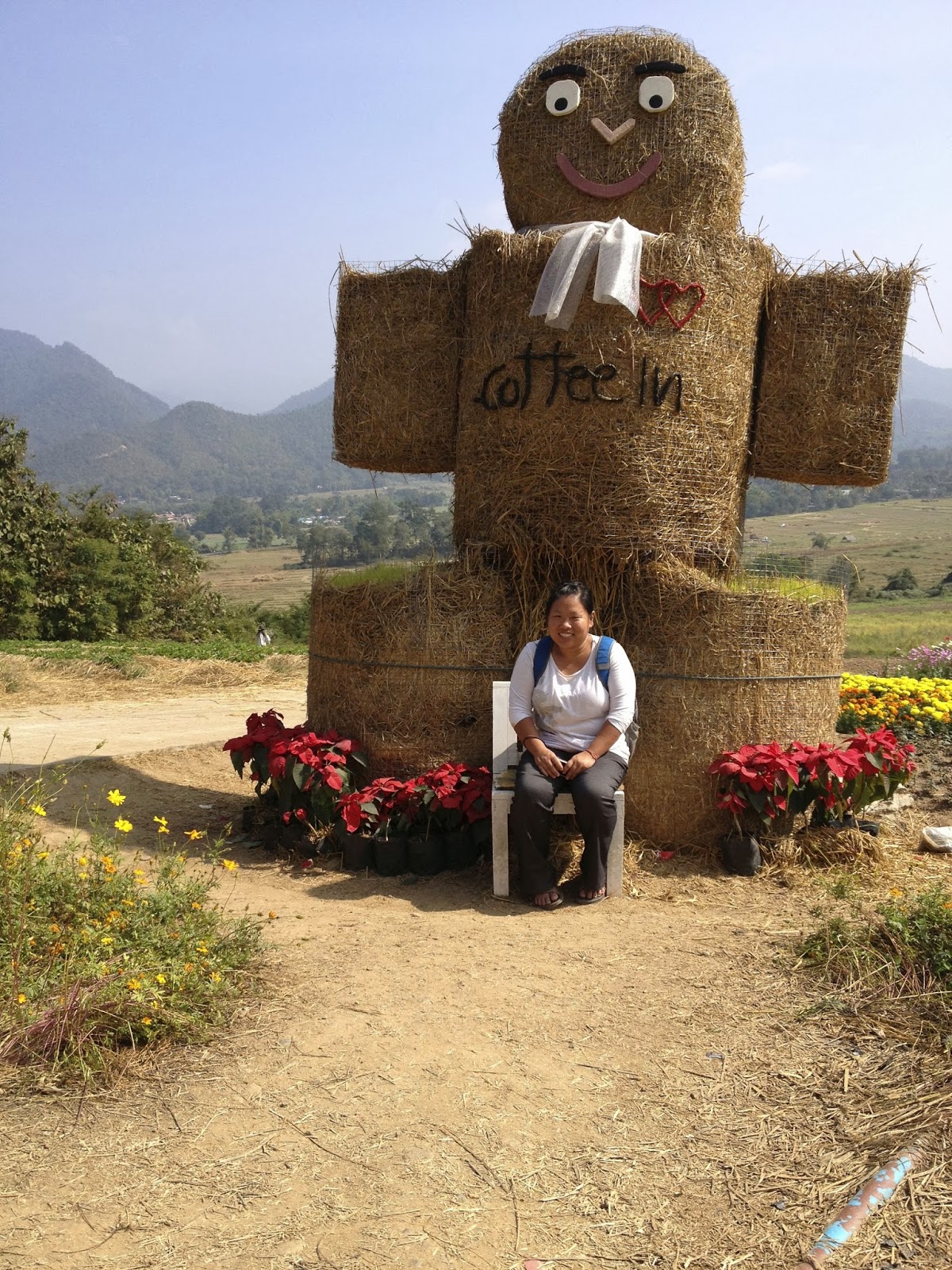
The coffee plantation has a huge house and beautiful grounds, but the coffee beans are grown elsewhere in the area. Coffee and strawberry cake at the café were excellent. Photo ops:
Yee and Weird Coffee Man

Me in Flower Field


A small canyon offered the opportunity to take short walks, photograph the surrounding mountains, and of course have our pictures taken:
Framed
By the time we got to the Chinese village, we’d had enough photo ops and passed up invitations to be photographed with several people wearing stunningly beautiful traditional Chinese garments.  I couldn’t resist the hand-operated ferris wheel though. 


Back in the village, the street market began setting up in the late afternoon. There were goods from several countries besides Thailand as well as crafts and fabrics from a range of hill tribes besides Hmong. There was no shortage of people wanting to pose for pictures, like these children:

 Of course, you’re expected to give them a little money after the picture is taken.  Comparing their costumes with pictures I found on the internet, my best guess is that the children are of the Lisu tribe. I had hoped to learn more at the Hill Tribes Museum in Chiang Mai, but it was closed for New Year’s.

Back in Chiang Mai on December 30 before returning to our sites, we made a last visit to the New Year’s festival.  Since New Year’s Eve was now almost upon us, quite a few vendors were selling koom fai (sky lanterns, also called Yi Peng), which work like miniature hot-air balloons. They were traditionally launched during the full moon of the twelfth lunar calendar month (usually in November in the Western calendar, and coinciding with the Loy Krathong festival). Later they became associated with New Year’s celebrations as well.  Here is a video of a couple sending up a lantern:


The lanterns floating through the sky are beautiful to watch. I read that there are usually a few reports of UFO sightings during events involving sky lanterns – not surprising. Ideally, the lanterns burn up their fuel and fall harmlessly to the ground (contributing to the litter problem but that’s another story). However, sometimes the lanterns don’t function correctly, fall while still burning, and start fires. Nothing is perfect.

As we were leaving, a passenger on our mini-bus told us about a Thai movie filmed there, Pai in Love (2009). Apparently the movie’s success contributed to Pai’s increased popularity as a vacation spot – people want to see where it was made.  Here’s a link to the movie trailer (with English subtitles). If you watch it, see if you notice any similarities between some of the landscape shots and my photographs.