Monday, January 13, 2014

New Year's Tourists


New Year’s Tourists

Look for this post to be long on pictures and short on content.  My New Year’s trip was to Chiang Mai and Pai in northern Thailand. Tours and treks that my PCV pal Yee and I wanted to take were at capacity before we even asked – but not before we’d bought bus tickets. Chiang Mai is a major city with a long history, a well-regarded university, numerous temples, a famous night market, and several excellent museums – which were closed for the New Year’s holidays.  Oh well.

So we had a lazy vacation, sightseeing, strolling, shopping and taking pictures.  Here’s a hotel we stayed at in Chiang Mai and the demon that guards it – note the similarity to the Grand Palace demons:
In Chiang Mai, we spent a couple evenings taking in the free entertainment at an open-air New Year’s festival and market with vendors hawking every kind of craft and souvenir and food stalls for every taste. Two emcees kept up an informative chatter (one speaking Thai, one speaking English) about the performances, with frequent reminders of the festival’s “no alcohol, no smoking” policy – unusual in Thailand, as far as I can judge. Among the entertainers were traditional Thai dancers, musicians and singers of various persuasions, and several groups of young male dancers in their teens, of the style I believe is called K-Pop. In between performances there were contests, raffles and prizes (festival T-shirts) for audience members. 


At the market we found many Hmong vendors with beautiful handmade clothing, pillows, quilts, table runners . . . you name it.  You are expected to offer less than the vendor asks – and if they accept your offer, you just bought something. I’m not good at bargaining, especially over goods that clearly took days or possibly weeks to finish.  But at least I know enough not to answer the question “How much you want to pay?” – if the vendor should happen to accept, see above. Yee speaks the Hmong language fluently (her family emigrated to the US when she was very small). I’m not sure what her conversation with the woman selling bedspreads was about, but the price went down 1500 baht (about $50) – so I bought one in my favorite colors. The picture shows about half of it – it’s harder than I thought to photograph a bedspread.  

 Want a receipt for what you bought?  Dream on.

From Chiang Mai, we went farther north to Pai, a four-hour mini-bus ride through the mountains. Pai is a scenic village with (of course) a street market, street entertainment in the evenings, many restaurants, bars and coffee houses, and various attractions that sound interesting but are mostly photo ops. For example, the strawberry farm has a modest-sized strawberry field, as you can see in the photo below:


 However, mainly it sells strawberry products – strawberry jam, dried strawberries, candied strawberries, strawberry wine, mugs with strawberries on them, etc.  The wine was unmemorable.  Here are a couple of the photos we took.
Yee in archway
Me as Giant Mutant Strawberry

The coffee plantation has a huge house and beautiful grounds, but the coffee beans are grown elsewhere in the area. Coffee and strawberry cake at the café were excellent. Photo ops:
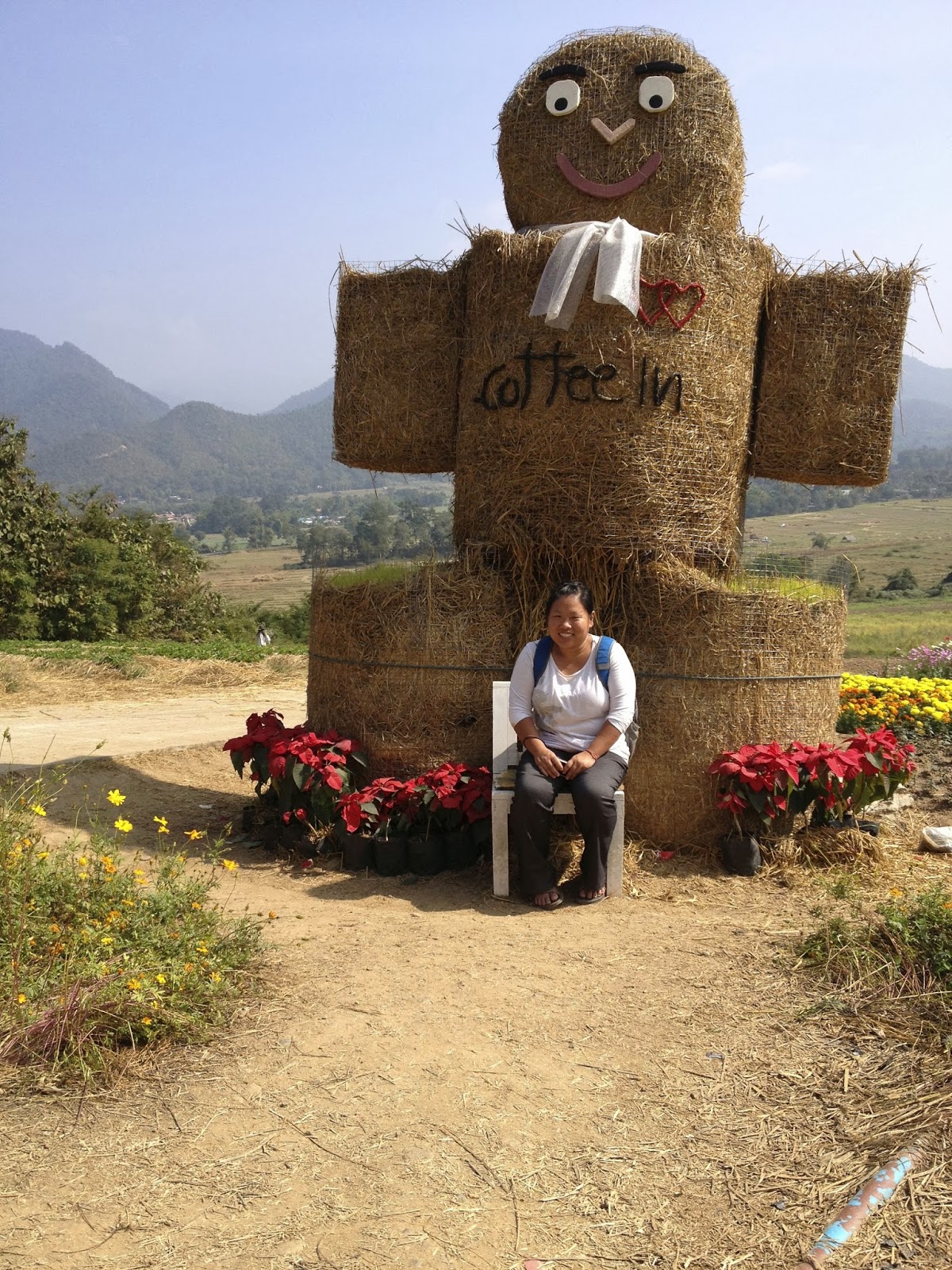
Yee and Weird Coffee Man

Me in Flower Field


A small canyon offered the opportunity to take short walks, photograph the surrounding mountains, and of course have our pictures taken:
Framed
By the time we got to the Chinese village, we’d had enough photo ops and passed up invitations to be photographed with several people wearing stunningly beautiful traditional Chinese garments.  I couldn’t resist the hand-operated ferris wheel though. 


Back in the village, the street market began setting up in the late afternoon. There were goods from several countries besides Thailand as well as crafts and fabrics from a range of hill tribes besides Hmong. There was no shortage of people wanting to pose for pictures, like these children:

 Of course, you’re expected to give them a little money after the picture is taken.  Comparing their costumes with pictures I found on the internet, my best guess is that the children are of the Lisu tribe. I had hoped to learn more at the Hill Tribes Museum in Chiang Mai, but it was closed for New Year’s.

Back in Chiang Mai on December 30 before returning to our sites, we made a last visit to the New Year’s festival.  Since New Year’s Eve was now almost upon us, quite a few vendors were selling koom fai (sky lanterns, also called Yi Peng), which work like miniature hot-air balloons. They were traditionally launched during the full moon of the twelfth lunar calendar month (usually in November in the Western calendar, and coinciding with the Loy Krathong festival). Later they became associated with New Year’s celebrations as well.  Here is a video of a couple sending up a lantern:


The lanterns floating through the sky are beautiful to watch. I read that there are usually a few reports of UFO sightings during events involving sky lanterns – not surprising. Ideally, the lanterns burn up their fuel and fall harmlessly to the ground (contributing to the litter problem but that’s another story). However, sometimes the lanterns don’t function correctly, fall while still burning, and start fires. Nothing is perfect.

As we were leaving, a passenger on our mini-bus told us about a Thai movie filmed there, Pai in Love (2009). Apparently the movie’s success contributed to Pai’s increased popularity as a vacation spot – people want to see where it was made.  Here’s a link to the movie trailer (with English subtitles). If you watch it, see if you notice any similarities between some of the landscape shots and my photographs.


Thai Days of Christmas


Thai Days of Christmas

I had expected this to be a short post – Thailand is a Buddhist country, Christmas isn’t a public holiday –how much could there be to write about? Read on.

December 24 was a teaching day.  I wore the fuzzy reindeer antlers that came along with the Christmas candy and cookies sent by my daughter, Airen, and taught my five classes a little about Christmas Eve, the hanging of Christmas stockings, and family dinners on Christmas Day. Each student got a peppermint candy cane. The rest of the candy was for the Christmas program on the 26th.
 December 25 was Scout Day.  I had been drafted to help my co-teacher with his “station” – there were 5 or 6 stations to be completed during the day, with activities related to nature and the outdoors, as you would expect. Our station, however, was billed as “ASEAN Languages” and consisted of trying to teach 12 groups of Scouts in turn how to say hello in 10 different countries. Cynic that I am, I suspected that this station was created to give English teachers something to do on Scout Day.

But I’m getting ahead of the story.  Before setting out for stations, Scouts and teachers lined up, milled around, and shivered (we were in the throes of a cold snap, with temperatures in the 60s – very unusual here) while waiting for opening ceremonies. Only the 8th grade Scouts were present; the others were at Scout camps, where they spent the night. Here is one of my colleagues in his Scout uniform.

 After flag-raising, the first stop was this tunnel made of branches.

 Each Scout had to crawl through the tunnel – presumably meant to simulate crawling through underbrush to escape danger in the forest? As you can see, the tunnel is low enough that students had to crawl through on their bellies. While they were in the tunnel, older students and a couple of teachers shook the branches, poured water over the tunnel, beat on it with sticks and poked sticks through. Needless to say, those who went through early on emerged much less wet and dirty than those who went later.  Watching the girls who were last in line go into the tunnel one by one, I thought about their mothers, who would have to try to get those white socks clean again.

After the tunnel activity, my colleague and I set out for our station a quarter-mile or so outside the village.  He told me that all pratom (elementary) students in grades 4, 5 and 6 and mattayom students in grades 7, 8, and 9 must participate in Scouts and aren’t allowed to continue in mattayom (=high school) unless they achieve all their Scout learning goals at the end of 9th grade. Doing a little research later, I learned that while Scouting is required in Thai schools, students at some schools can choose other options, such as the Red Cross. However, in our village, other options aren’t available.  I also learned that Scouting was founded in Thailand in 1911 by King Rama VI, that Thailand was a charter member of the World Organization of the Scout Movement in 1922 and the third country in the world to take up Scouting. Who knew?

We were finished at our station by mid-afternoon, when the last groups of Scouts straggled out of the woods or across the field, many of them caked with mud.  They tried gamely to learn the 10 greetings, which they no doubt forgot again before the day was over – just as I did.  On the way back to the village, my colleague talked about how much he had enjoyed Scouts as a boy, and expressed pleasure in seeing our students in good spirits at the end of their day.

So that was Christmas Day.  December 26 was a teaching day that began with a Christmas program outdoors, on the court where we gather each day for flagpole. I had been asked to talk about Christmas and prepare quiz questions, with prizes (candy and cookies from my stash) to the teams who gave correct answers. We set up a table with a small artificial Christmas tree surrounded by bowls and boxes of candy and cookies. The chubby student whom my colleague had persuaded to wear a Santa Claus suit was a real trooper, steadfastly guarding the candy and patiently standing the Christmas tree up again each time it tipped over, approximately every two minutes.

The program wobbled to a start about 20 minutes late – which is almost on time by local standards. Using large flash cards of Christmas scenes, I was trying to teach the students to say “Christmas tree,” “Christmas stocking,” “Merry Christmas” and so on, when the microphone quit working.  Things quickly unraveled after that.  A teacher took the microphone to try to fix it, but returned a half-hour later with the message “No microphone.” Meanwhile, students couldn’t hear what we were saying, so they chatted among themselves and started edging toward the candy. To distract them, one colleague launched an impromptu game of Simon Says, then for reasons known only to him, taught a small group of students to count to ten in Japanese.

Eventually someone brought a different microphone that sort of worked, so I tried to finish telling about Christmas and organize teams for quiz questions (“How many reindeer does Santa have?” “When does Santa bring presents for children?”), but by this time the students, who had been waiting too long for their candy, were out of patience – and who can blame them.  After giving out a few bags of cookies to teams that did manage to answer a quiz question, we resorted to distributing treats at random and hoping that everybody got some. Thankfully, quite a lot of students were still not back from Scout camp or the chaos would have been greater.  –- In the confusion, I couldn’t take pictures, so I leave this event to your imagination.

Note to Self: Remember, technology can and will fail.  Next year, have a back-up plan.

At some point on 12/26, Airen and I met virtually to open presents together.

The first class day in the new school year brought one more Christmas-like event. New Year's gift exchanges are a long-standing Thai tradition, one that I knew nothing about before coming here.  At our school, students exchange gifts in their homerooms.  Each student brings a present (there is a price limit to keep it more affordable), resulting in a stack like this:

My co-teacher set the exchange in motion by drawing the name of a student to hand over the first gift. As you can see, she was instructed to give the first one to me.

 
 The box contained little packages of snacks, which I tossed to the children.  
 
Then the girl who had handed me the present drew a number, and the student with that number gave her the gift he had brought.  As each student handed over their present, they had to say "Happy New Year" – which was harder than you might think for a few of them. The process was repeated until all the gifts had been given.
 
 As you can see, we’re all wearing jackets or sweatshirts -- the cold snap was still on.  The buildings aren't heated (normally there would be no need for heat, or at least not more than a couple of days a year) – but this cold snap lasted for a full three weeks, much to the dismay of the Thais, accustomed as they are to being too hot – but not to being cold. At our school, New Year’s gifts are exchanged not only by students but also among the teachers, at a special meeting called by the principal. I’ll spare you my pictures of that event.

So there you have my Thai Days of Christmas. In Bangkok and other larger cities with many foreign residents, Christmas is much in evidence during December. Shopping mall checkout employees wear Santa Claus hats. Media advertising features Christmas trees, holly, and gift recommendations. Piped music plays Jingle Bells and Rudolph the Red-Nosed Reindeer. But local priorities dominate upcountry, as northern and northeastern Thailand are called.


"We Keep Our Traditions Alive"


“We Keep Our Traditions Alive.”
Loy Krathong and other Thai Traditions on Parade

Loy Krathong is a Thai water festival celebrated on the full moon of the twelfth lunar month.  The word loy means to float, and the krathong is the decorated object, often shaped like a lotus, which is floated on the river. Homemade krathong are constructed of a piece of banana tree stalk, banana leaves, flowers, a candle, and an incense stick.  Here is a picture of some larger ones from our weekly Peace Corps newsletter:
 The purpose of floating krathong is to pay respect to the Lord Buddha and to the goddess of water, or, in the words of a fellow-teacher:  “We thank the river for the water we have used and we apologize to the river if we have offended her.” You can also put all your negative thoughts into the krathong and let them float away. Parades, beauty contests and other competitions are part of the festival as well.

Loy Krathong has many opportunities for students to participate, especially dancers and marching bands. When my co-teacher told me that quite a few of our students would miss two days of class (one to rehearse and one for the parade), I grumbled about so much lost teaching time, having already missed classes during Sport Week in early November. He replied simply:  “We keep our traditions alive.”  – I guess you can’t argue with that.

I watched two Loy Krathong parades, one in a nearby village and one in the town that is the center for our amphur (=district within a province) and want to share a few images and impressions from each. 

The parade in the nearby village was on a Sunday afternoon, November 17th. I had been told it would start around 2pm, but actually, that was when the participants started assembling to find their spot in line. The parade started much later. Here are pictures of two displays I liked.
  1. The photos show you two ends of the parade float spectrum. The one on the left looks like a gigantic krathong and, in my opinion, deserves a prize for artistry and symmetry. I’m not sure, but the little figures at the top might be the King and Queen. Every parade I’ve seen here includes multiple images of Their Majesties.  I thought the display on the right was a wonderful collage of fertility/fruitfulness images. Having it pulled by an ordinary tractor, the kind you see every day going from village to field and back again, honors the farmers who thank the water spirits for their harvests.
 While waiting for everything to get organized, people passed the time drinking beer and dancing.  Here is a brief video of dancers with puppets of a type I hadn’t seen before:

As you can see, the puppet-master/dancer carries the puppet apparatus on his shoulder, and poles are attached to his legs to make the puppets behind dance when he dances. Despite the heat (I sweltered in the shade of a tree), the dancing went on for the better part of an hour – and who knows how much longer after I left.  In the video, you also see a man with a balloon under his shirt to simulate pregnancy – one of many cross-dressers waiting for or taking part in the parade.  Here are some others:


 I asked several colleagues what the significance of the cross-dressing is. The only answer I got was: “They think it’s funny.” That might be the right answer for the man with the balloon belly or the guys in the photo above left, but the ones on the float in the photo on the right seem to be all about glamour. I wondered if they were part of a beauty contest, but never managed to find out, since I had to leave before the end in order to bike safely back to my village before dark.


The second parade, in our amphur town, was the following Tuesday.  It was very long, lasting more than two hours, and again, I couldn’t stay to see who won prizes. Here are some dancers from our school, getting ready.  


Monday, December 23, 2013

Grand Palace, Great Museum


Grand Palace, Great Museum
The Queen Sirikit Museum of Textiles

The Grand Palace in Bangkok is overwhelming. As you may know, it’s not “just” a palace, but a large complex of buildings constructed over time, far too much to take in during one visit. My photography skills, limited as they are, weren’t up to the task of capturing my impressions either, but here are a few images that turned out well enough.

I don’t remember which building this is, but the Demon Guards are formidable and the roof is beautiful. You see similar statues guarding other buildings in the Royal Palace complex and at many historic sites in Thailand.

How this handsome Chinese guard got here is another mystery, but he was too photogenic to be ignored.

In one area, a number of irresistible golden statues are grouped. The figures are either part human and part animal, like the lion-tail girl, or part animal and part demon, like the chicken-tail guy – I think.  Sometimes it’s hard to tell which is which – but the figures are very lovely and mystifying.


The demons holding up the chedi (a Buddhist shrine) got my attention too – I hope the artists who created them enjoyed making them so beautiful and sinister.


 Before long, my camera ran out of battery, sparing me the trouble of trying to find angles for decent photos.  After making our way around the complex and dutifully checking off most places on the map, a friend and I had some expensive but excellent ice cream before deciding to take in the Queen Sirikit Museum of Textiles. It was a good decision. The museum is air conditioned and arranged in an orderly fashion, so it was a great antidote to the sprawling monumental grandeur outside in the hot sun. It wasn’t very crowded; and taking pictures is not allowed, which is too bad in a way, but also good because everyone concentrates on the exhibits, not on taking pictures. Finally, and more to the point, the museum gives you a good introduction to HM the Queen and her patronage of Thai arts and crafts.

As you might expect, one part of the exhibits consists of dresses and suits that HM the Queen wore to important events during the years when she and HM the King were most active, beginning in the 1960s. She wanted her wardrobe to incorporate elements of traditional Thai clothing and styles, such as the shoulder cloth (prae wa), the wrap skirt (phaa sin – a wrapped straight skirt), and the hip wrapper (phaa nung – wrapped and tucked to create pleats at the hips).  You can see examples on the museum web site if you are interested: http://www.qsmtthailand.org/collection_main/
The web site is interactive, so you can click on images to see details.

The exhibits also tell about the international designers with whom HM the Queen and her staff worked to create the fashions she wore (she was named to the Best Dressed Hall of Fame in 1965) and about different kinds of Thai silk. The most famous Thai silk is mat mii (also called Ikat), made of tie-dyed silk yarn, a process that requires great skill on the part of the dyer/weaver. The silk strands are wrapped and tied at intervals before being dyed, and unwrapped after being dyed. The pattern then emerges during the weaving, yielding a fabric with a characteristic shimmer from the yellow of the undyed sections of the silk. Here is a link to a YouTube video that shows you how it is done:

The most eye-opening parts of the exhibit were the videos and documentaries about projects that Their Majesties undertook to help poor people become more self-sufficient. In the videos you see them touring various “upcountry” areas of Thailand – predominantly agricultural areas in the north and northeast.  The videos document HM the Queen’s interest in collecting fabrics created by weavers in remote villages in order to locate and preserve traditional textiles. Some of the traditional weaves were incorporated into the fabrics the Queen chose for her official wardrobe. Typical patterns are from nature (flowers, leaves, seeds) arranged in a repeating diamond shape. Two examples that you see a lot in Thai silk are a four-petal flower and “heads of rice,” sometimes with a pattern of vines, enclosed in the diamond figure. You can see examples of these and other patterns on the museum web site.

HM the Queen encouraged many weavers and other artisans (mostly women) to earn extra income to support their families by making and selling their crafts.  She bought many of their products herself. In 1976 she created a foundation with the acronym SUPPORT, which stands for SUPPlmental Occupations and Related Techniques. Its purpose is to support and promote folk arts and crafts, and preserve them for the future. There is a training component for people who want to learn new techniques and a program to help artisans, such as weavers, obtain better equipment so they can increase their production and better support their families.  It’s moving to hear the women interviewed in the videos tell about how they were helped by HM the Queen’s patronage, and how much respect they have for her.  Seeing the exhibits, I understood why HM the Queen is so loved and revered by many Thais.

To conclude, I’m posting a picture of my landlady at the loom that stands between our two houses. She is weaving a more utilitarian fabric, not one for royal wardrobes – but I like to think that if she had been weaving 50 years ago, she might have met HM the Queen on one of her tours of the northeast.

 For the record: HM the Queen is not the only patron of Thai silk.  One you may have heard of was an American businessman named Jim Thompson, who brought Thai silk to international attention after WWII.  There is a museum about his work, the Jim Thompson House, in Bangkok that I haven’t visited yet – maybe soon! Stay tuned.


"Under Conditions of Hardship if Necessary"


“Under conditions of hardship if necessary”

When the Peace Corps was created in 1961, JFK famously asked Americans to serve where they were asked to go, “under conditions of hardship if necessary.”  That phrase probably evokes images of physical hardships such as walking long distances to get water or chopping wood before you can cook dinner. Peace Corps Thailand is sometimes half-seriously called “the posh corps” because Thailand is a relatively developed country where even a rural upcountry village like mine has electricity and running water almost all the time. Just in case, though, most everyone in the village has large water storage tanks like the one in the picture below, for the possibility of prolonged drought.

I think most PCVs (Peace Corps Volunteers) in my group would agree that the inconveniences we deal with at our sites don’t rise to the level of hardship – which is not to say that nothing is hard. Much that we take for granted in America – administrative support for teachers, classrooms with doors and windows that close, some level of instructional technology (copy machines, projectors, computers, etc.) – is absent or in short supply at rural Thai schools. For class handouts and tests, most teachers use their own computers and printers. Our classrooms, like our houses, must be swept twice a day to keep dust and dirt under control. Some classrooms have computers and projectors, like the one below:

The picture above was taken on a Wednesday, the day students wear their Scout uniforms. The picture below shows Level 4 students in their assigned room, which is typical of the classrooms for the primary grades (the uniforms tell us this picture was taken on a Tuesday). 


The next picture is the English classroom for Mattayom students (=junior high and high school).  Nobody thinks twice about sitting on the floor.  Students seem to use the computers at the back of the room mostly for Facebook, but there is a projector for teacher use as well. 


Conditions that make teaching a challenge include noise, teaching load, and class cancellations. Our school has quite a bit more noise than I remember from American schools – children yelling outside or reciting at the top of their lungs in the next room, workers using saws, drills, or weed-whackers right outside the classroom, loudspeaker announcements, and more. You get used to most of these after a few weeks or months – up to a point. Occasionally, when the din is simply too great, I tell the students to do their math homework until the noise dies down again.

Teaching loads vary somewhat by school. PCVs don’t have sole responsibility for classes, but co-teach with one or more Thai teachers.  This term, there are about 130 students total in the six classes (4 different levels, 18 hours a week) that I co-teach with two English teachers – which seems like a lot to me, spoiled college teacher that I am, but probably looks familiar to many teachers – and is the envy of fellow PCVs with classes of 30 or 40. PCVs learn to cope with this too – as one philosophically said, “There’s not that much difference between 30 and 40.”

The workload is much higher for the Thai teachers than for us. All the Thai teachers I’ve met have significant responsibilities besides teaching and homeroom. A few examples are record-keeping (not just their own grades, but various official reports that must be submitted up the educational hierarchy); administrative duties such as staffing the school’s savings bank or the school store; helping serve lunch in the cafeteria; preparing the schedule of classes; serving as registrar; coordinating set-up, tear-down, and hospitality for events. Most teachers are advisors to student clubs; they also coach sports and groom students for academic competitions—a time-consuming activity that will get its own post eventually.  As a PCV, I have only one regular non-teaching assignment: to be at the school gate by 7:30am each Monday to greet students in English as they arrive.

Teaching at a rural Thai school makes you rethink your ideas about what is essential for teaching and learning. I can’t speak for others, but for me, the hardest thing has been to accept the fact that lost instructional time is just lost – and no one seems concerned about it. Schedules are unpredictable. We often lose days or parts of days for events announced at the last minute. We face classes with half or more of the students absent for participation in an approved activity (sports, dance, band, academic competitions, festivals, special computer training, etc.). We are expected to let these students make up the missed work, but good luck finding a time to do it.

Besides the lack of a plan for making up lost class time, there are no substitute teachers when someone is absent for illness, to take care of family business, or to attend a conference. The teacher is expected to leave an assignment for students to complete in her/his absence. The Thai teachers are used to all this and just seem to roll with it. I get frustrated because, unlike adapting to “old” technology or larger classes or dusty classrooms or even excessive noise, lost class periods make it much harder to teach effectively. Sometimes, after not seeing students for a week, the previous lesson is a hazy memory at best and the only option is to reteach.

What do these practices say about school priorities? I think that school directors and the education ministry want students to have a rich co-curricular experience – certainly a worthy goal – and expect flexibility in the academic curriculum in order to accomplish it.  And actually, I think it’s great that the arts – dance and music – are treated the same as sports, for example, and that students are encouraged to take more advanced computer classes than our school can offer. Still, the situation reminds me of a pizza that began with a few ingredients – let’s say tomato sauce, cheese, sausage, and mushrooms – and then other ingredients were added – pepperoni, onions, ham, pineapple, green peppers, artichokes, chicken, anchovies, and more – until the crust could no longer support the toppings. I think the crust of the pizza – our school’s academic curriculum – is being stretched too thin. Trying to hold my part of it together under these conditions is, to me, the hardship of teaching in rural Thailand.


Friday, December 6, 2013

To Market, To Market


To Market, to Market,
And Round About the Village

Open-air markets are everywhere in Thailand, but not all are open all the time.  In my village, the market is only on Mondays, in the late afternoon and early evening.  In a previous post (“Say Wat?”), you saw pictures of our village’s two temples.  The weekly market is set up in a field just opposite the grounds of Wat Sirinamaram.  The market offers an impressive range of items, given the small size of the village – besides meat, produce, and freshly cooked or baked items (curries, soups, salads, desserts), you can buy clothing, shoes, junk food, toys, kitchen utensils, cleaning supplies, personal hygiene items, bug spray, CDs, DVDs, and much more.  Here are a few photos to give you a glimpse of what it looks like:

I don’t know who decides which food vendors sit on the ground while others get a stall or table, but presumably there is a fee for each category. Some vendors from the area make the rounds of different markets throughout the week, as I discovered by visiting weekly markets in nearby villages. Besides the wide variety of fried or grilled meat, chicken, and fish items (photo on right) and other prepared foods, a self-respecting market in northeastern Thailand must offer a selection of fried or roasted bugs, as in the photo below.
Sorry, but I can’t tell you what kind of bugs or worms these are or how they taste – being a vegetarian, I haven’t partaken of these, um, menu items.  The play area for children (below left) is available most every week, and there are barkers who keep up a running banter over loudspeakers, giving the market a festive feeling, a little bit like at a county fair.  The snake show has only been there once that I know of (photo below right).

You can see the cobra curled up on a corner of the mat while its owner works the crowd, trying to collect as much money as possible before the performance. I didn’t stay to watch, having seen the snake show last summer at King Cobra Village near Khon Kaen, which mainly made me feel sorry for the snakes. After removing them from their boxes (like the one here), the handlers goaded the cobras to strike, picked them up, slung them around their necks, put their heads (the snakes’ heads) briefly into their mouths (the handlers’ mouths), and performed other maneuvers that are not for the squeamish (not saying that anyone reading this is squeamish, but the writer might be). The snakes were quick to dive back into their boxes when their shift was over.  Here is a link to the web site for more about King Cobra Village if you are interested, or you can google to find YouTube videos of parts of the show:
http://www.tourismthailand.org/See-and-Do/Sights-and-Attractions-Detail/Ban-Khok-Sanga-king-cobras-village--3478

Back to my village: during the week, you can buy some groceries and other necessities at one of the numerous little stores, such as those in the photos below.

 The stores in the pictures are only a half a block from my house, and I usually shop at both each week.  The one above left is similar to a convenience store. It sells drinking water (tap water in Thailand is not safe to drink) and other drinks, household supplies, toiletries, school supplies for children, random toys, and a large array of snacks and junk food, but no meat or produce. Also, you can take your cell phone and internet access cards there to be “topped up” – the usual way to pay these bills here.  So I buy my drinking water at this store, pay to have my sim card topped up, and buy my favorite Extra Barbecue Potato Chips when I’m craving salt after a sweaty bike ride. 


The store in the picture above right is a grocery store, where you can buy whatever vegetables and fruits are in season, fresh eggs, and meat (pork, chicken, and fish most days). I buy tomatoes, little eggplants, squash, and other vegetables here, and maybe a watermelon once in a while. (Jeanette’s Rule for Buying Fruit: Don’t buy bananas, especially when they are abundant and already ripe, because as soon as you do, at least three people will give you large bunches from the banana trees in their yards.) 

Every village I’ve been to in Thailand has a goodly number of little “mom and pop” stores like the ones pictured above, often three or four in the same block, or right across the street from each other. Presumably each has regular customers and the people who run the stores don’t depend solely on income from sales to support their families. In towns and cities, the role of the convenience store has largely been taken over by 7-Elevens (called simply “Sewen” by Thais), but I haven’t seen them in villages yet.

Two more stores to round out this mini-tour of my village: the little station where motorcycles buy fuel, and the bike repair shop:

Some of our 5th-grade students happened to see me taking the picture of the motorcycle fueling stop and called out “gas station!” (one of the words they learned in our unit about the village), a moment to warm any teacher’s heart.  In the photo of the bike repair shop, the proprietor is working on a motorcycle (called “motocy” in Thai), but you can tell from the pile of tires that he also repairs bicycles.  He replaced my inner tube and patched the old one for 20 Baht (30 Baht = about $1 US) – I would gladly have paid more, because even though I had a spare inner tube and bike tools provided by the Peace Corps, it would have taken me an hour or more to do it myself, while he did it in less than ten minutes. 

There’s more to tell about where I live, but today I wanted to show you that many of the things we need can be bought right here, round about the village, within minutes of our homes.


It's Look Like Rain


It’s look like rain.
More on Teaching English in Thailand

A 6th grade student stopped by my desk one morning with a Thai/English phrase book and pointed to a sentence she wanted me to see:  “It’s look like rain.”  It did look like rain that day – it was the rainy season.  I complimented the student for learning English and told her how to say the sentence correctly:  It looks like rain.  She gave me a blank look and pointed to it again.  I said, yes, it looks like rain, fon dok, rain means fon dok.  This seemed to satisfy her and she went on her way.

The sentence illustrates a common mistake in Thai English. The fact that it appeared in a published phrase book suggests that Thai speakers don’t easily notice or correct this error on their own.  Maybe it reminds you of Americans trying to sort out its and it’s – but that’s a different kettle of fish. Those two words are pronounced alike, so you can’t really get them wrong in speaking, only in writing – or when blindfolded, as in the cartoon below, (from Mrs Milarch’s Class Website, http://mrsmilarch.weebly.com/funny-grammar-d.html).
 Back to the topic:  As so often happens, once “It’s look like rain” had crossed my radar screen, I started to hear similar errors rather often; here are a few examples:

a) It’s mean “really,” jing jing. 
b) What’s was the last country to join ASEAN?
c) Yes, the capital city, but what’s country?

I heard sentence (a) from a Thai speaker with a good command of English who was explaining vocabulary to me.  Sentences (b) and (c) were from Thai English teachers quizzing students about ASEAN (= Association of South East Asian Nations). The sentences are jarring to an American ear (at least, to mine) because the word “is” shouldn’t be there, not even in a contraction. Thai students of English learn these contractions early in their language instruction, in sentences such as:

d) What’s your name?
e) What’s this?
f) It’s hot today.                                
g) It’s raining.                                                           
                                   
Teachers reading this will probably agree that it makes sense to teach the contractions “it’s” and “what’s” because the sentences sound more natural than “What is your name?” or “It is raining.” In the process, some learners may not realize that the contractions actually stand for two words. Even if the grammar of “it’s” and “what’s” is explained to them, learners may easily forget it again, just as Americans (such as Yours Truly here) constantly forget the tones in Thai that signal important differences in meaning. It’s hard for us to remember the tones because English doesn’t have them. It’s hard for Thais to learn to use “is” because many common expressions in Thai have no equivalent for English “is.” Thai versions of the above sentences, if translated word-for-word into English, look like this:

d) What’s your name?                                 Your name what?
e) What’s this?                                              This what?
f) It’s hot today.                                             Today hot.
g) It’s raining.                                                 Rain.

Sentence (g) illustrates another Thai/English difference: Thai verbs don’t add endings in the he/she/it form.  Not surprisingly, Thai people usually omit this “s” when speaking or writing English (as in the sentence “It’s look like rain”).  Moreover, there is no difference in Thai between “it’s raining” and “it rains”:

g) It’s raining.                                                            Rain.
h) It rains every day.                                                Rain every day.

So, are the teaching of contractions and the different rules for when to use “is” the whole reason why Thai speakers use “it’s” and “what’s” in English sentences where the word “is” doesn’t belong?  Maybe.  However, looking at the sounds [t] and [s] made me think that other aspects of English and Thai may come into play as well. 

First, the two sound systems don’t match up well. The sounds “t” and “s” are not identical in Thai and English; that is, what Americans hear as “t” in English, for example, may not sound like a “t” to Thai learners, who have a different kind of “t” stored in their mental warehouse of speech sounds. I can cite many examples from teaching to illustrate this, e.g., the students say “foosball” and find it very difficult to imitate my correction to “football,” or they say “saut” for “sauce” and again find it hard to produce a more correct pronunciation.  I think the difficulties are due at least in part to the imperfect match between the Thai and English sounds.

Another possible factor is Thai spelling:  the Thai letters that correspond (more or less) to English “s” are often pronounced “t” in syllable-final position. For example, consider the following words, first spelled letter-for-letter from Thai to the English alphabet, then written as pronounced.

English                        Thai in English spelling          Pronunciation
Hello.                           swasdii                                   sa-wat-dee   (ee as in see)
Country                      pratees                                   pra-teet (ee as in entrée)
Religion                      sasna                                      sat-sa-na

I think this aspect of Thai spelling could be another source of confusion to learners struggling with a new language and a new alphabet. Anecdotal evidence that might support this theory comes from students trying to write their names or nicknames in English spelling. For example, a student who told me her nickname is “Net” signed her homework paper “Nes.”  Another student, whose name is pronounced “Suparat,” signed her homework “Supalas” (for r/l substitution, see the post “Sound Barriers” from several weeks ago).  Besides the difficulties that Thai people have pronouncing words that end in the sounds –s and –t (often interchanging the two), I’ve heard some speakers add “s” to words that didn’t need it, so it wouldn’t have been necessary to make the effort (e.g., “I thinks it will be in the afternoon.” “The students go with their grandfather to works in the field.”).

Baffled by all this, I started telling my fellow teachers what I was hearing and asked if they had any insights to offer.  Two Thai colleagues, independently of each other, gave an answer that surprised me. The gist of it was that Thai people think, if you add a lot of “s” you are speaking English.    Hmm, I thought, that’s not a very kind thing to say.  But then I thought about how much “s” there really is in English:

·      -s to make third-person singular verbs (he/she/it lives, runs, gets, etc.)
·      -s to make nouns plural
·      -s for possessives (my parents’ house)

None of the above patterns are at all similar in the Thai language. As mentioned above, Thai verbs don’t add endings for the he/she/it form. Thai nouns don’t add endings to form the plural. The possessive isn’t formed by adding an ending, but with a preposition (similar to “the house of my parents’). All these uses of “s” in English must be a never-ending thorn in the flesh of Thais learning English, making it really hard to remember when you should and shouldn’t use it.

So, given all the above sources of confusion, maybe the comment that you should use “a lot of ‘s’” when speaking English isn’t unkind or totally far-fetched. Who could blame Thai speakers struggling to learn English if they followed an unofficial rule along the lines of “when in doubt, add –s.” 

Why not?  It’s could be right!

* * * * * * * * * *
Disclaimer: As always, please remember that my descriptions of learner errors are only descriptions, not criticisms. Also, while I’ve tried to be accurate in choosing my examples, this is hardly a scientific study, so feel free to poke holes in my analysis but try not to take the conclusion too seriously.  – Or, as some of my Thai colleagues say:  Don’t serious.