Sunday, August 17, 2014

Sukothai Historic Park


Sukothai Historic Park

Our bike tour of the Sukothai historic park began at our hotel. Our guide from the day before brought bikes to us and we rode the short distance to the town. The first pictures, below, were taken outside the enclosed section of the park. I liked seeing cows grazing among the ruins.


Note the cows’ long ears. Our guide said that the cows with the long ears are not slaughtered. The ones with regular-length cow-ears are the ones used for meat.


This small chedi surrounded by elephant figures is also outside the enclosed park. I’m including this picture because it turned out well, not because I know the significance of the chedi or what relics it may contain.


Entering the park, our guide explained that unlike many medieval cities, Sukothai had four entrances, north, south, east, and west. We began on the northern side, with a visit to Wat Si Chum and The Talking Buddha.

A very famous image


The story as told by our guide is that the King took advantage of the physical layout and acoustics of this temple to create the illusion that the Buddha image could speak, though of course the actual speaker would have been a monk or other person in the king’s service. This subterfuge was used to give courage to the soldiers before an upcoming battle – the voice would exhort them to be brave and uphold the honor of the king and the city. The solders, who must have been assembled outside the niche where the Buddha image is seated, were no doubt convinced that it really was the statue speaking to them. In the photo with the close –up of the Buddha image, you can see a small window high up on the wall to the left. There are tunnels that gave access into and around the structure on both sides, but they are closed off now.

Not far from Wat Si Chum and The Talking Buddha is this ruin of a chedi, which dates back farther than the Sukothai kingdom. There were three of them together at one time, but only this one remains somewhat intact.


The guide explained that this chedi is in the style of the Khmer (i.e., Cambodian), shaped like a phallus rather than the rounded shape topped by a spire that is typical of Sukothai (as in the chedi with the elephants seen above). The phallus-symbolism goes back to earlier, non-Buddhist religions. I hope to understand the Khmer influence on Thai architecture and art better after visiting Cambodia later this year.

To the east you find this large square ruin with many Buddha images, such as the large Standing Buddha in the second picture.


Standing Buddha


The grounds in this area of the park are especially beautiful, with more long-eared cows grazing and trees that are so symmetrical, it seems that they must have been trimmed and groomed into shape. However, our guide said they just grew that way.


Mango tree in the background


At temples. you often see banyan trees like the one below with little images tucked in between the roots. It is believed that spirits reside in these trees. The images are there to remind us of them.


Banyan Tree


At temples and in parks, you also often see colorful strips of cloth wrapped around banyan trees; supposedly this is to keep the spirits in the tree.

Below is a picture of our guide talking with Kathleen about something. I’ve mentioned him so often, I thought you should see him.


Moving on through the park, we circled around this beautiful pond, which serves as a kind of reservoir, collecting rainwater for the town.


Toward the final one-third of the tour, the images and monuments began to blur together, but I want to show you a few last pictures.  Here is a famous Walking Buddha image from the park.


 The next two pictures show a Buddha image that was used at one time to hide relics and other valuable objects to keep them safe from marauding Burmese or other enemies. In the picture on the right, you can see very clearly where surgery was performed on the statue’s belly to remove the objects.


With surgery scar


The next picture is a statue of King Ram Kham Haeng, the most famous of the Sukothai kings. He is much revered as a strong king politically and as a scholar who created the Thai alphabet. Sorry the picture is so dark – the sun was going down.


Finally, this picture of the palace, taken as the light was fading fast. We chose to end our tour here, rather than trying to squint at inscriptions and images in the dusk.


Sukothai is widely regarded as the beginning of Thai art and architecture, distinct from Khmer and other influences. To understand it all better, I plan to go back in time, to a historic site in Cambodia, and forward, to the historic ruins of Ayutthaya in Thailand. Ayutthaya was an important kingdom that partly overlapped with and then succeeded Sukothai as the center of power for a time.  – Meanwhile, I hope you enjoy these pictures.


Sukothai Countryside by Bike


The Sukothai Countryside by Bike

Thailand had a four-day weekend recently: because the Queen’s birthday / Mother’s Day (August 12) fell on a Tuesday, the Monday was declared a public holiday as well – a step toward encouraging tourism, which has been flagging. I spent the weekend in Sukothai, a north-central province. The city of Sukothai was the center of an early Thai kingdom (mid-13th – mid-16th C). The ruins of the old kingdom have been designated a UNESCO historic heritage site, beautifully maintained as a historic park. A fellow PCV, Kathleen, and I agreed that the best way to visit the ruins was by bike, and booked a tour online. However, there was a communication malfunction  -- the other two people in the group had requested a tour through the countryside. Since they were leaving the next day and we were staying for two more days, we opted to go with their plan – the guide could obviously do only one tour at a time. It turned out to be a super all-day tour.

We set out through villages, along the canal.The guide, who is excellent and speaks very good English (learned, he said, from watching American movies), explained that the canals were the primary means of transporting people and goods to and from the old kingdom. Our first stop was a furniture-making cooperative -- a loose organization, open to any craftsman or –woman who needs space to work and a means for sharing the expenses of the buildings (work space, storage space, show room), permissions to sell or to use specific woods (e.g., teak), and other costs. Here are a few pictures to give you an idea.

Woman working on a cabinet

Wood curing

Showroom


Continuing the tour through rice fields, we stopped to hear about the storks that eat the snails infesting the fields. Our guide said the storks had been imported to the area, though it wasn’t clear whether from somewhere else in Thailand or from another country. Here is a picture of a rice field with mountains on the horizon. I think the white specks in the distance (on the right) are storks – but I guess you know what storks look like anyway. Every time I tried to take a picture of storks that were closer by, they flew away disdainfully. Hmph.


 Our next stop was a family-owned and operated business that makes rice wine and schnapps (called lao in Thai). The smell of the mash cooking was quite, um, pungent. We each got a small glass of the wine to sample (mild-tasting with no discernible intoxicating effect), and a sip of the lao (burned the tongue as you would expect). Here are a few pictures:

Sipping and listening

Cooking the mash

Some of the pigs who eat the dregs from the process


The operation is very efficient, since the family makes only what they know they can sell and nothing is wasted. They sell their products only locally. Any aspects of the business that might perhaps be questionable are overlooked by the customers.

At some point we stopped for snacks, which the guide had brought with him – fried banana chips, mangosteen and other fruit, kanom (that all-purpose word for any sweet or salty snack food you don’t know the name of). We asked the guide what the people in the area think about the government and the plan fur returning the country to civilian rule. He almost started to talk about his opinions, then thought better of it. Not surprising.

Next we visited a family that smokes catfish for sale in Bangkok and other large cities. They don’t catch the fish themselves, but receive deliveries from their suppliers a couple of times a week. In the pictures below you can see one of the women tending a fire (picture on the left). Embers from the fire will be used to start smoky fires under the rows of fish on the table in the picture to the right.  It is hot, difficult work, but it seems that the finished product is much in demand and brings a good enough price to sustain the business.

Getting the fire going

Catfish waiting for smoke


After cycling a few more kilometers, we stopped for a great Thai lunch at a restaurant run by a friend of our guide. He ordered about 8 different dishes for us to try, half of them vegetarian. The variety was much appreciated by the others in our group, a young couple from Belgium, who had not been to Thailand before.

Riding further, we passed a temple where we stopped to listen to the story of this pig.


 The story is, she was in a truck with other pigs being driven to the slaughterhouse. Somehow she managed to jump out of the truck and run to the nearby wat. When the monks found out where she had come from, they bought her because, they believed, the fact that she had escaped the slaughterhouse meant she has good karma. She has now lived at the wat for several years, relaxing in this puddle or other comfortable wallows, depending on the season. No picture of the wat, sorry.

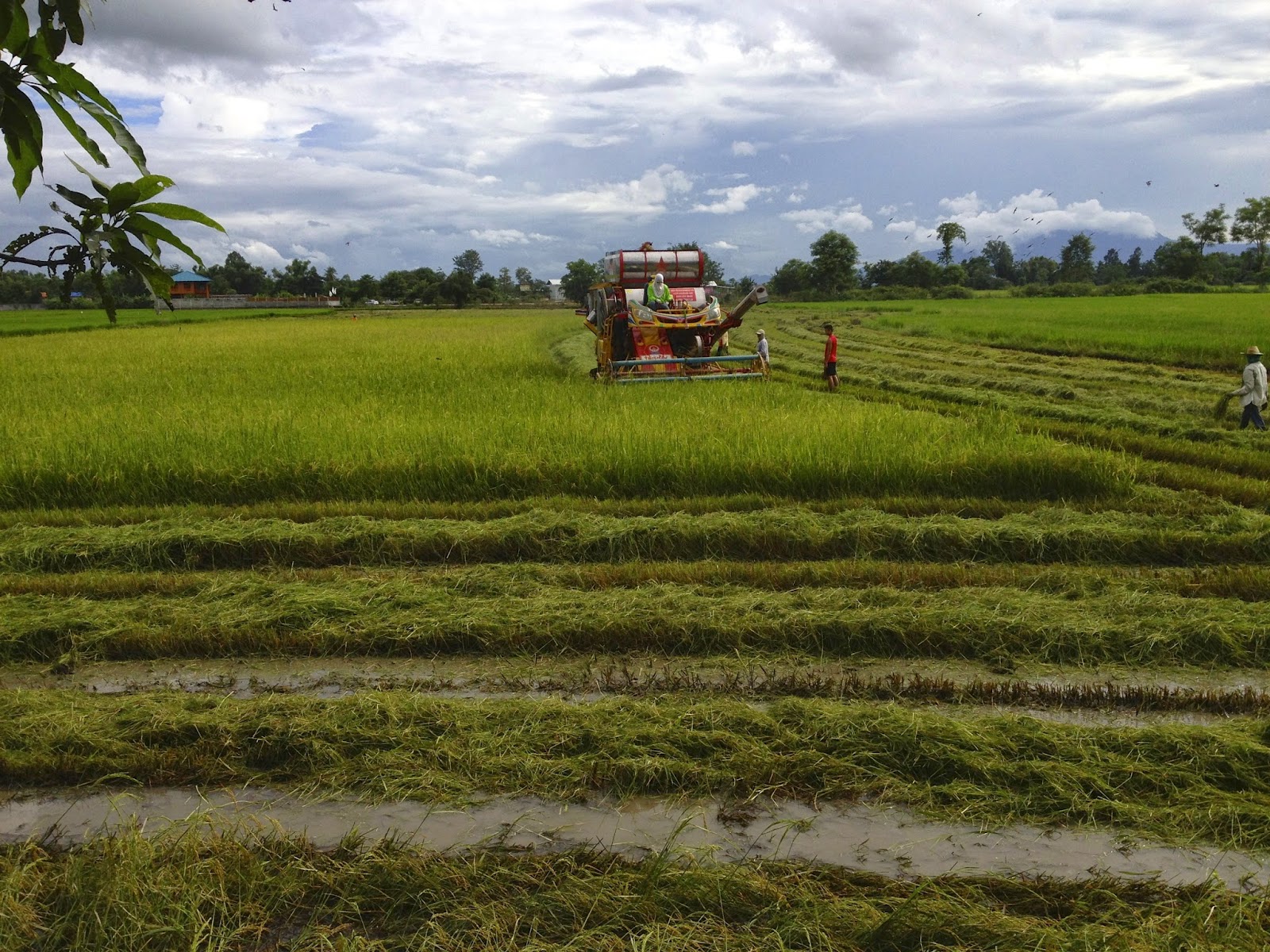
The continuation of our bike ride included a visit to a temple founded by one of the royal princesses and a stop to chat with villagers catching fish. I have no interesting photos from either of those. However, here is a photo of farmers harvesting rice.


 You can see that the field is very muddy, but the combining takes place anyway. The men standing in the field are catching rats tossed by the combine or scared into jumping out of the stalks. Our guide said the men and their families would have the rats for dinner that evening – probably true; it’s well known that rats and field mice are eaten by rural families in the northern and northeastern provinces of Thailand. The guide assured us that these rats are quite wholesome because they eat only rice and other natural ingredients in the rice field. I suppose that rats with a diet of fresh foods (rather than rotten garbage, like city rats) might not taste much different from other wild game, such as squirrels. But let’s not pursue that line of thought any further.

At the end of the ride, we stopped to visit a couple who make baskets, fish traps, and frog traps out of bamboo – again, friends of the guide.


Our guide said we had biked about 50 km in all – not far when you have all day to do it and many stops for learning about small businesses in the area. Kathleen and I were actually glad the young couple had requested the tour of the countryside, because on our own, we would probably have overlooked it. And anyway, our guide gave us a short version of the historic parks tour the next day – see separate post for pictures.


Nang Yai Shadow Theatre


Nang Yai Shadow Theatre
Wat Khanon, Ratchaburi

Nang Yai is a form of traditional Thai puppet theatre dating back to medieval times, when it was an entertainment for royalty. The plays depict episodes from the Ramakien, Thailand’s national epic, with a plethora of gods, humans, and other characters of an intermediate status, such as Hanuman the Monkey King. In Thai mask theatre, Hanuman is always depicted with a white face, since he’s one of the good guys. There is also a black monkey who symbolizes evil. The color-coding helps you keep track of who is doing what to whom on the stage.

Today, the art of Nang Yai is preserved at only a few sites in Thailand, most notably at Wat Khanon, a temple complex in Ratchaburi Province. Wat Khanon offers Nang Yai performances at 10 a.m. every Saturday and maintains a museum to preserve and display original shadow puppets. The puppets used in the performances are replicas; the project of replicating the originals was funded by HRH Princess Maha Chakri Sirindhorn. A few weeks ago, a fellow PCV and I attended a performance at Wat Khanon. 

The word nang yai literally means “big hide” – the elaborate figures used in the play are incised into cowhide, painted, and attached to a frame for carrying them during the performance. Here are a couple of photos taken in the museum, where you can get up close enough to see details.


As you can see, the figures don’t have moving parts. They are held and moved by dancers who act out the story recited by a narrator and accompanied by music.


The performances are free. My PCV friend and I sat close to the front of the auditorium, surrounded by schoolboys who had arrived in two large buses. I had a hard time keeping the taller boys' heads out of my photos during the performance. The students had no doubt been briefed by their teachers about what they would see. We, alas, had not -- so I can only show you some of what I saw, but can't interpret it for you. Here is a brief video of the musicians playing before the performance began.


 Sorry the video ends so abruptly – the music is quite repetitive though, so maybe this brief snippet gives you an idea.

As you can see in the videos below, the performers are all men and boys. In the first one, you hear the narrator speaking – his voice was so strong and his speech so clear that I could almost follow what he said – but sadly, not quite. For example, you can hear him say “keng kan” (=competition) but who was challenging whom wasn’t clear to me.


 In the next video, you see the performers assembling for some kind of crowd scene, accompanied only by the music this time.


In the next video, you see that one of the performers is behind the curtain, rather than in front. I'm nor sure what the significance is as far as the dramatic action is concerned.


I have quite a few more videos of this performance but, not knowing the story, don't feel comfortable posting them. I need to learn more about Nang Yai before writing more about it. I've read that the Ramakien epic was derived from the Hindu Ramayana, and that the shadow puppet theatre form was adapted from an Indonesian model. But I don't know what is considered to be the essential "Thainess" of either the Thai epic or the Thai shadow theatre, let alone how to interpret the performance we saw.  Stay tuned. Meanwhile, here’s a link to a website with some historical information if you are interested.

http://www.thaiwaysmagazine.com/thai_article/2410_nang_yai/nang_yai.html


Tuesday, July 29, 2014

Candle Festival


Candle Festival
Ubon Ratchathani

The Candle Festival ushers in the start of Buddhist Lent in Thailand, also called the Buddhist Rains Retreat. It begins on the day of khao phansa (literally, “entering the rainy season”) and lasts for three lunar months. This year, it began on July 12.

The candle festival tradition goes back to an event in the Buddha's life: Seeing that monks wandering outside the temple compound during the rainy season might easily step on newly planted crops or accidentally kill insects, he proclaimed that they should study and meditate within the monasteries instead. They must spend the night in the same temple each day during the three-month period, which restricts their movements to collect alms, so Buddhists bring them gifts of food and other necessities of daily life. In earlier times, candles were important gifts, since they were the primary source of indoor light. The practice of making large, ornate candle sculptures depicting stories from the Buddha’s life evolved from this practice.

The most famous candle festival in Thailand takes place in Ubon Ratchathani in northeastern Thailand. The sculptures are hard to photograph because of their size, the plethora of figures on each one, and the complexity of detail. My knowledge of Buddhist stories is essentially nil, so I can’t identify the figures or events, but maybe the photos will give you an idea of the variety of the sculptures and the skill of the artists who carve them.  Here are two parts of an entourage led by a demon; he is followed by what appears to be a pack of slave drivers. 


The sculpture below features horses and chariots:


And here is one headed by an eagle leading a whole menagerie of mythical and realistic animals:


 The above pictures were taken the night before the parade, “backstage,” where floats and marchers were lined up along several streets, patiently waiting for instructions. Here are some pictures taken during the parade the next day.  The two below are parts of a sculpture that made great use of color: 


And another that uses a range of colors:


Besides the sheer size and complexity of the candle sculptures and the incredible attention to detail, what struck me most was how similar the images are from one candle to the next. That is, the demons on one candle have the same features as the demons on the next one; the horses, women in armor, men in helmets, Buddha images and other figures all look very much alike -- at least, to my outsider's eye.

Of course, the parade didn't consist solely of candle sculptures. There were many dancers, musicians, and other performers who waited with admirable fortitude in the nearly 100-degree heat for their group to move ahead. Here is a short video to show you what I mean -- these dancers had been waiting for perhaps 20 minutes, but kept their smiles beautifully when the procession started to move forward again:


The dancers in the video exemplify the pride that Thais take in maintaining their cultural traditions and sharing them with others. This is true not only of adults but of students as well -- at least, the students at both my schools participate willingly and competently in every traditional event or performance that comes along. I see it as one more facet of the collectivist culture.

Besides parades to display the candles, which are then presented to the temple, the festival in Ubon Ratchathani featured street markets, carnival rides, and vendors hawking a large variety of wares. My PC volunteer friends and I were stopped numerous times by gaggles of students wanting to interview us – apparently most of the local English teachers had given the same assignment for the weekend, because all the students asked the same questions. Here is one of our group being interviewed:


Just for giggles, a friend and I rode the ferris wheel. Here's a picture I took from my seat, and one of the sunset as seen from the top of the ride. 


I guess you had to be there . . .

 
The Ubon Ratchathani Candle Festival deserves its reputation as one of the premier festivals in Thailand.

* * * * * * * * *

P.S. Walking home from school after writing this post, I was caught in a downpour and spent about 20 minutes under an awning waiting for the rain to subside. Also under the awning, for the same reason, were a woman who works at the temple next to the school, several construction workers who are renovating a building, and a few monks. After a few minutes, I thought I smelled incense. Then, glancing around the group, I realized: No, that monk is smoking weed. Ah, Thailand!


Asarnha Bucha


Asarnha Bucha and
The Start of Buddhist Lent

Asarnha Bucha Day is a Theraveda Buddhist observance that commemorates the Buddha’s first sermon. It is a public holiday in Thailand, celebrated on the full moon day of the eighth lunar month, the day the Buddha delivered the sermon. This year it was on July 11th.  Since schools are closed on public holidays, our school celebrated the day before.

Asarnha Bucha is observed by praying, listening to sermons, and bringing gifts to temples. The students and teachers at our school worked hard to prepare two large candles and two money trees, to be delivered to two temples in our district. Here they are on the day before the event.


In the morning, the candles were loaded onto pickup trucks, to be driven through the village as a mini-parade before being delivered.


Children in traditional Thai costumes or other finery rode on the trucks too. As you can see, the little girl second from right in the first photo (below, left) wasn’t happy about her starring role in the parade; she pouted the entire time. It was hot -- who could blame her.


Boys with drums rode in a third pickup truck.


 The trucks were driven slowly along the village streets, with students walking along beside. I rode in one of the pickup trucks . I offered to walk with the students but was told in no uncertain terms to stay in the vehicle. I’m not sure whether this was out of consideration for my advanced age or, possibly, because I might have drawn attention away from the students. Carrying branches to add to the money trees, they stopped at houses and stores along the way asking for donations. Usually these came in the form of 20-baht bills inserted into the slots in the branches, but occasionally there were larger bills as well.

After the village had been thoroughly canvassed, it was time to deliver the candles and money. One delivery was to Wat Trakam-en, the temple for our Tambon (a subdivision of a district).  Here are pictures of students kneeling with gifts and offering gifts to monks.


After the gifts had been presented and the monk had chanted prayers, we counted the money from the money tree.  It came to more than 10,000 baht. My co-teacher told me that the monk returned the money to the students, for the school. Of course the students were very proud and gratified.


Next, the second candle and the other money tree were delivered to Wat Rang Krathai – the temple with the bunnies out in front, adjacent to our school.  Here are a couple of pictures of students kneeling to offer the gifts. You can see that the walls of the temple are brightly painted with images from the life of the Buddha – one of the more colorful and beautiful temple interiors I’ve seen.


This time, I didn’t stay to help count the money. Again, the funds were returned to the students, for the school, in what is apparently an annual tradition, one that creates a strong sense of belonging and, no doubt, loyalty to both the school and the temple.


Wai Kruu 2014


Wai Kruu 2014
At Ban Rang Krathai School

Last year I wrote about Wai Kruu Day at my school in Northeastern Thailand, but didn’t have pictures of my own to publish. This year, at my new school, I made sure to remedy that.

Ban Rang Krathai School is smaller than my previous school. It has about 200 students and only goes through 9th grade. The students assembled in the school cafeteria.  Here is a picture of the banner announcing the event (Wai Kruu Day, 5 June 2014), followed by a picture of the students waiting for the ceremony to begin.


Below, you see students with the bouquets they will present to the school principal. The two kindergartners in the front row were such troopers about holding their bouquets upright until it was their turn to go forward. In the other picture you see the school principal accepting a bouquet and patting the little boy’s cheek. The kindergarten teacher is on her knees behind the children, having accompanied them to the front of the room so they would know what to do.


In the video below, you see two students performing the deep wai, then continuing on their knees to present their bouquet to the principal before moving around the half-circle of teachers, still on their knees.


 Even after living in Thailand for a year and a half, I still feel uncomfortable watching the students walk on their knees.  They are used to it, of course – they must walk on their knees in the temple too, when presenting gifts to the monks on Buddhist holidays and other occasions.  Knee-walking can be pretty uncomfortable. I winced watching boys trying to pull the legs of their shorts down far enough to protect their skinned knees.  I winced again seeing the little girl who uses a walker on her hands and knees, being half-dragged by other students to bow to each teacher.  She was smiling though – glad to be doing what everyone else was doing.

Wai Kruu is one of many Thai traditions that cement relations within communities and reinforce a collective identity.

To conclude with a different perspective, here is a picture of Kem (which means “salt”), one of the dogs belonging to my host family. She accompanies my host sister and me to school every day, and tries to hang out near one of us. She was neither impressed nor put off by Wai Kruu.


Wednesday, July 9, 2014

A Funeral in July


A Funeral in July

The mother of one of my co-teachers died unexpectedly. A week elapsed between the time of death and the cremation, on a date deemed by the monks to be auspicious. I participated in two mourning rituals, a service at my co-teacher’s home early in the week, and the service on the day of the cremation several days later.

I don’t have pictures from the service at my colleague’s home, thinking it wouldn’t be appropriate to take pictures at such an event. Soon after we arrived at the house, an evening meal was served, good ordinary Thai food, no special funerary foods as far as I could tell. Chairs were set up under an awning. We waited about an hour and a half for the monks to arrive. They chanted, the deceased woman’s husband made some remarks, and the monks chanted some more. Then the monks went inside the house, to the small altar at the end of a large room. Different groups of people went in and came out. I went in with my school principal and a few other colleagues when it was our turn. We kneeled, presented gifts to the monks, and bowed. I can’t remember if they chanted again. Soon after we came out of the room, the service seemed to be over and we went home.

The cremation was on a Thursday afternoon at this small building. It looks like a small temple, which I suppose it is, but it is also a crematorium.


The service was held in this space – I’m not sure what to call it. It’s a large meeting room with windows on three sides.

 The head monk who performed the main chant sat on (not at) the table you see at the front. The other monks (8 of them) sat on the window seat to the right. The vase of paper flowers were an opportunity to give money – you insert a bill into a slit in the flower stem. Again, there was a wait for the monks to arrive. While we waited, a group of musicians played twice – a drum, a trombone, two cornets, and cymbals. The music was loud, cacophonous and so terribly sad that I wanted to cry.


Students from our school were offering glasses of water on trays. Several electric fans were working to move the air, if not cool it. After the monks had finished chanting, there was another wait for the coffin to arrive and be carried up into the crematorium. It arrived on this wagon.


We were all given paper flowers to lay next to the coffin as we filed past. After that, most people left. We waited until we saw the smoke coming out of the chimney.